

Roundel Media, the media and data platform of Target Brands, Inc., focused in its Holiday Season 2025 report on consumer behaviour, motivation and shopping habits, drawing on extensive first-party data and research conducted among customers of the major US retail chain Target. The result is a report offering interesting insights into when people start their Christmas shopping, what brings them joy, which categories they spend the most in and how marketing communication affects them.
Joy is the key emotion driving shopping behaviour
The report's fundamental pillar is that the primary driver of shopping behaviour is the joy customers experience in retail stores. Customers believe that Target has everything they need for the festive season — from exceptional gifts to everyday essentials. This is also reflected in campaign performance: return on ad spend (ROAS) for Christmas advertising reached USD 5 in 2024, the total number of Christmas impressions increased by 14% year on year, and site traffic during the season grew by 61%.
Customer joy can take several forms. The three main areas in which customers may experience joy include:
- Joy in saving: 86% of customers prefer practical and useful gifts.
- Joy in gatherings: far more people than last year are planning to host family or friends, up 68%, or to attend a family gathering, up 40%.
- Joy in gifting: 78% of people take part in mutual gift exchanges, while the phenomenon of buying gifts that consumers give to themselves has also increased significantly.
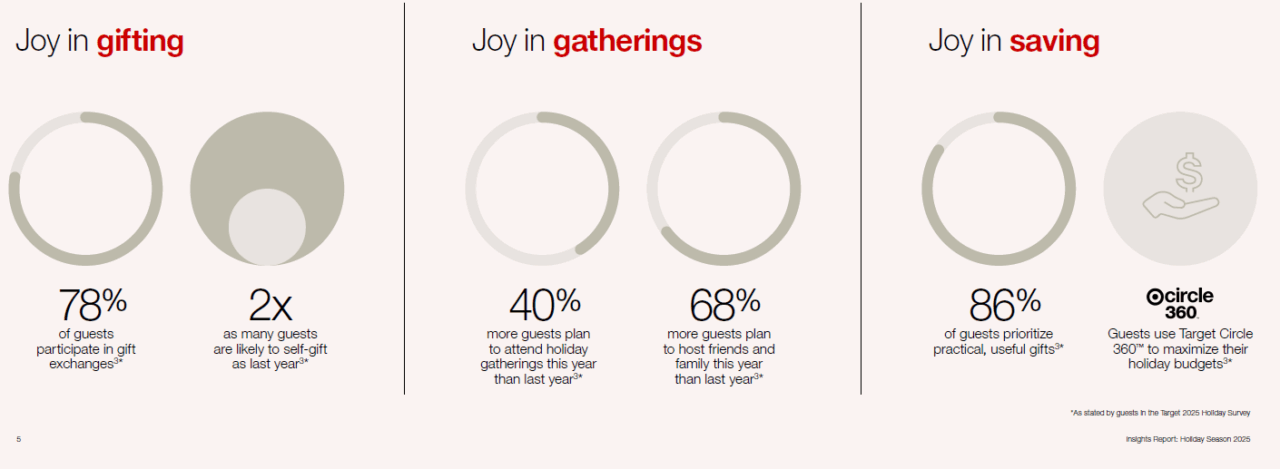 Source: Holiday Season 2025, Roundel.com
The Christmas season starts earlier than we might expect
The report shows that the Christmas season begins as early as October. In October, almost a third (31%) of customers start planning gifts, making impulse purchases or buying gifts for themselves. Other consumers only begin planning and buying gifts in November. In addition to good-value gifts, Christmas decorations are also purchased in large quantities. It is therefore important to focus on discounts and inspiration that help customers with their choices. The turn of November and December is when major shopping takes place — 62% of customers do most of their shopping roughly three weeks before Christmas. The pre-Christmas period in December is the time for “last-minute” gifts. After Christmas comes the sales period: 89% of customers are open to post-Christmas shopping, and almost half plan to spend some money on themselves too. This makes it an ideal time, for example, for gift cards or wellness products.
What do people spend the most on?
The report states that 38% of customers shop seasonally, which means they need to be reached at the most important moment. Each category has its place at the “festive shopping table”. So how do the individual product categories perform during the Christmas season?
The most frequently purchased Christmas gift is toys — almost half (45%) of customers plan to buy them during the Christmas season. They say there is nothing more beautiful than the sparkling eyes and broad smile of a child when they unwrap an amazing doll or action figure. The toy category shows strong performance: ROAS for 2024 was 8, while sales increased by 81% compared with the average for the previous three-month period.
 Source: Pixabay.com
Entertainment — books, music, films and games — also performs very well, helping customers feel comfortable and cosy during cold winter days. The entertainment category appeals to almost half (49%) of shoppers. Gift cards are the clear leader in terms of popularity, with 67% of customers planning to buy them. ROAS for this category in 2024 was 12, while sales increased by 80% compared with the average for the previous three-month period.
A relatively large group of customers buys the latest technology and devices during the Christmas season, such as cameras to capture beautiful moments, televisions to watch festive classics, or game consoles to enjoy some friendly competition. Some 31% of customers plan to purchase electronics, while 39% purchase items worth more than USD 100. In this case, ROAS for 2024 was 9, and sales were 70% higher than the average for the previous three-month period.
As the New Year and New Year’s resolutions approach, the sporting goods category becomes increasingly important. Sporting goods are considered a good-value purchase, with 6% of customers adding this type of product to their cart even though it is not on their shopping list. When it comes to choosing specific sporting equipment, 22% of customers acknowledge the influence of social media. Compared with the previous categories, performance in this category is weaker. ROAS for 2024 was 8, while site traffic increased by 36% compared with the average for the previous three-month period.
 Source: Pixabay.com
The category of Christmas decorations and storage solutions reflects the practical side of the Christmas period. Christmas ornaments, fairy lights and other decorations help create the festive atmosphere, but there is also the question of how to store them efficiently once the holidays are over. And how does this category perform? ROAS for 2024 was 8, while traffic increased by 52% compared with the average for the previous three-month period. Interestingly, however, Christmas campaigns in 2024 generated more than one million impressions, suggesting stable demand and strong media potential for this category.
In the beauty and essentials category, we can see a combination of practical purchases, gifts for others and personal-care items, with 57% of customers saying they want to look and feel good during Christmas. In terms of the structure of purchased products, 45% of customers plan to buy beauty minis, 84% seek cleaning supplies to help them with Christmas cleaning, and 35% of customers are planning to include essentials in their shopping lists. ROAS for 2024 stood at USD 6.
 Source: Pixabay.com
Apparel and accessories are, of course, among the traditionally strong pillars of the season. These are gifts with perceived personal value, combining practicality with emotion. According to the report, more than half (63%) of customers consider clothing to be a valuable Christmas gift. Campaign performance confirms the strong commercial potential of this category: ROAS reached 8 in 2024. Christmas campaigns also recorded around 320 million impressions, indicating both high reach and a competitive environment. However, it is important to remember that customers are particularly price-sensitive in this category, meaning they look for discounts and buy “last-minute” gifts.
Kitchenware also plays an important role, as cooking, baking and sitting down to a meal are closely linked to the experience of the Christmas holidays. In performance terms, Christmas campaigns in this category achieved ROAS of USD 8 in 2024, while sales of kitchenware rose by 6% compared with the average for the previous three-month period. The influence of social media is also significant — 21% of customers admit that they take inspiration from social media when buying kitchen products.
Food and beverages are undoubtedly among the biggest drivers in the run-up to Christmas. A significant peak occurs even before Thanksgiving. In November, 20% of all Christmas sales come from the food and beverage category. The second strong wave comes just before Christmas — site traffic in the week of 22 December increased by 30% year on year, and sales on the day before Christmas Eve rose by 19%. From a marketing performance perspective, Christmas campaigns in this category achieve ROAS of 5. The report also highlights the importance of in-store communication and advertising, which supports basket-building with last-minute items, small gifts and products for festive refreshments. The food and beverage category confirms that Christmas is not only about gifts under the tree but above all about shared moments around the table.
 Source: Pixabay.com
Finally, there are various snacks and candies, without which no holidays — including Christmas — would be complete. Some 65% of customers plan to buy them as a budget-friendly gift, while 80% see them as ideal stocking stuffers. This category is often associated with last-minute purchases — sales on the day before Christmas Eve rose by 19% year on year, and site traffic increased by 31% compared with the average for the previous three-month period.
Advertising works
The report confirms that 30% of customers are motivated by advertising to buy Christmas goods. According to the report, social media and in-store product advertising have the greatest influence.
Budget is an important issue for customers — and this also applies to the pre-Christmas and Christmas season. The report therefore recommends basing advertising communication on clear value, discounts and special offers. Product advertising that emphasises the price-to-practical-value ratio helps customers make decisions and reinforces the feeling that they are shopping smartly and without unnecessary stress.
One of the report’s most important findings is the need to start communication early. Customers begin planning as early as October, so brands should build awareness before the main December peak. At the same time, the report points out that the Christmas season does not end on Christmas Eve — 89% of customers plan post-Christmas shopping, often focused on discounts, self-care and new beginnings. Communication that extends into January is therefore also an important part of a successful retailer strategy.
Source: roundel.com