

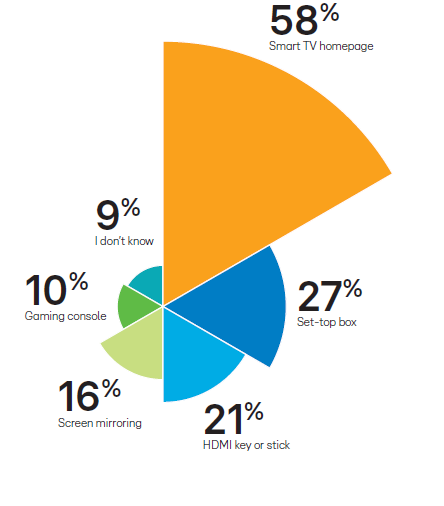
Streaming is no longer confined to mobile phones or computers. Today, it often starts directly on the television screen — specifically on the smart TV homepage. Although viewers in European households have a wide range of ways to access streamed content, the television interface is the most common entry point.
The living room as the centre of activity
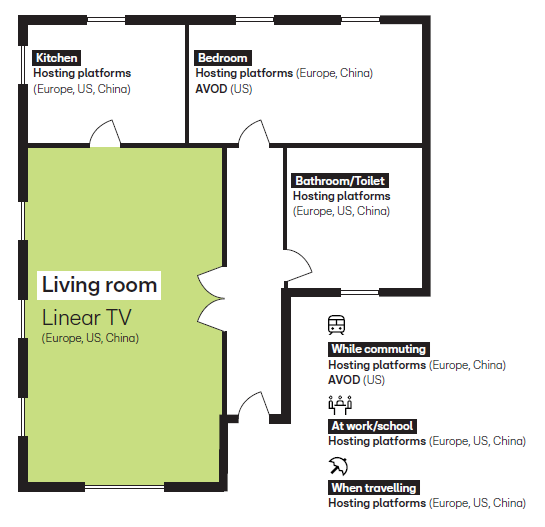
The research shows that the living room clearly dominates as the place where video content is watched: it is there that 86% of Europeans most often watch linear television, while the bedroom trails far behind at 22%. Looking at video content more broadly, around 83% of respondents identify the living room as their main viewing location, which demonstrates its enduring dominance. Compared with other regions, the differences are significant — the preference for the living room in Europe is roughly 20 percentage points higher than in the United States.
Shared viewing brings people together
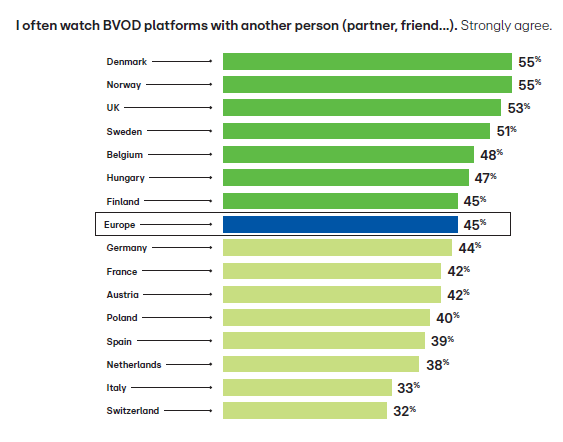
Shared viewing remains an important part of the television experience in Europe. Despite the growing range of platforms and individual devices, people still often watch content together — television thus continues to function as a space for shared moments. 45% of Europeans regularly watch content on BVOD platforms with a partner or friends.
This phenomenon is even stronger among younger generations. However, the share of people who agree that shared viewing strengthens social bonds varies across age groups: 68% of respondents aged 18–24 agree, 63% in the 25–34 group, 40% among those aged 35–49, and 54% in the 50–64 group. Shared viewing is therefore not merely a habit, but also an important social element — it allows emotions to be experienced collectively, encourages communication, and distinguishes the television experience from the individual consumption of content on personal devices.
Television content remains the primary choice
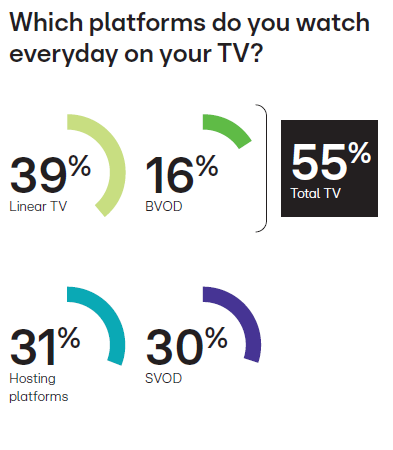
Television content — that is, the combination of linear television and broadcasters’ streaming platforms (so-called Total TV) — remains a daily part of viewing in Europe. 55% of Europeans watch Total TV every day. This confirms that traditional television content — whether broadcast live or delivered via BVOD — remains a firmly established part of everyday viewing habits. The chart below provides an overview of the platforms watched on television every day.
Streaming on television is a normal part of everyday life
Streaming has become a normal part of television viewing in Europe, with consumption increasingly shifting to the big screen. What was once associated primarily with mobile devices is now naturally consumed on television sets across households and age groups. The use of streaming services on TV is widespread — for example, SVOD services are watched by 80% of Europeans at least once a month and by 68% at least once a week, while video platforms with user-generated content, such as YouTube, reach 72% monthly and 58% weekly, and BVOD reaches 61% monthly and 45% weekly.
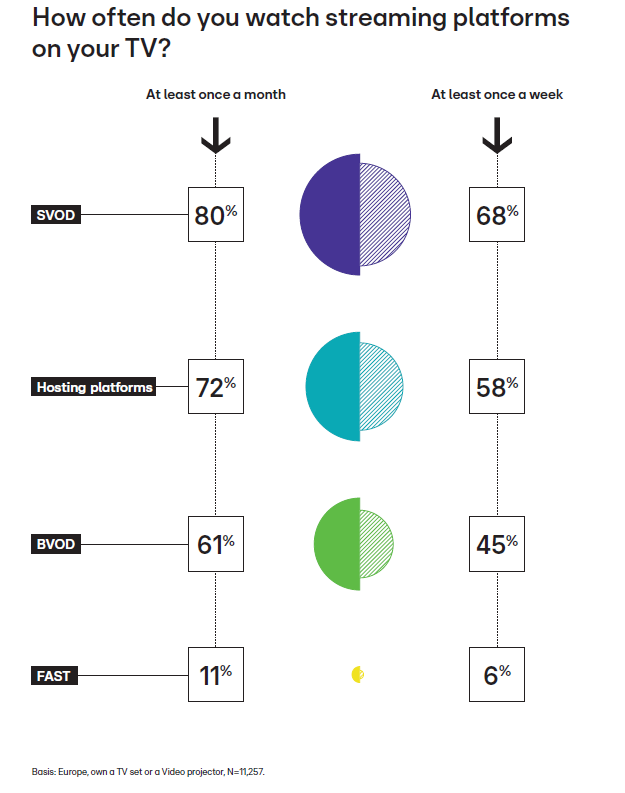
Streaming is therefore no longer a supplement but a fully-fledged part of television viewing. Viewers expect easy access to content directly on the television screen, and the technological development of smart TVs is reinforcing this trend even further.
BVOD is succeeding across generations
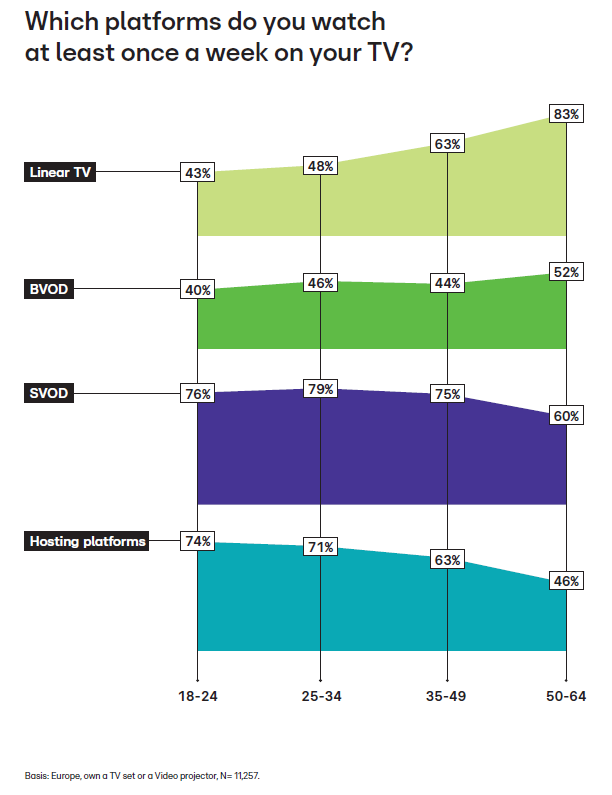
As the chart below shows, linear television still leads the platforms. It is watched at least once a week by 43% of viewers aged 18–24, 48% of those aged 25–34, 63% of those aged 35–49, and as many as 83% of viewers aged 50–64. The data thus confirm that while younger audiences are more likely to combine different types of platforms, linear television remains dominant, especially among older age groups, and continues to hold a strong position across the population.
A similar trend can now be seen in broadcasters’ streaming services (BVOD), which are becoming a normal part of viewing in Europe across all age groups. It is no longer the case that these services are used only by younger viewers. Weekly viewing reaches 40% among the 18–24 group, 46% among 25–34-year-olds, 44% among those aged 35–49, and 52% among viewers aged 50–64. This relatively balanced spread across generations shows that BVOD has become a firmly established part of everyday television behaviour.
At the same time, the way BVOD is used is also changing. Although these platforms were long associated primarily with catch-up viewing and watching programmes from the archive, viewers today also use them for current broadcasting — 41% of Europeans watch live content on television through them. BVOD combines the flexibility of streaming with the advantages of traditional television, allowing viewers to watch content whenever they want while remaining connected to live broadcasting and the shared television experience.
A distinctively European viewing culture in the era of global streaming platforms
Even in an age dominated by global streaming platforms, Europe continues to maintain a distinctive viewing culture built on the strong role of local content and traditional television. Unlike other regions, such as the United States, where international streaming services dominate, traditional television broadcasting remains deeply rooted in Europe. The result is a hybrid model: European viewers mainly use global platforms for on-demand content, while live broadcasting, shared television experiences, and local productions remain the domain of linear television.
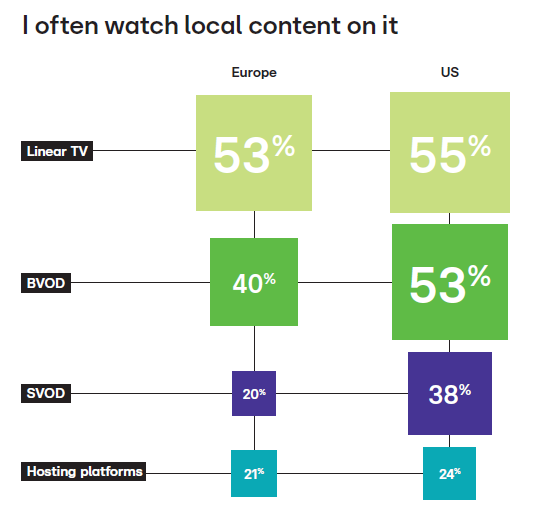
Local content plays a crucial role in Europe. It is most closely associated with traditional television broadcasting and with services operated by television broadcasters. It shapes audience preferences, strengthens ties to national culture, and makes a significant contribution to the kind of content people choose to watch. The data show that 53% of viewers in Europe most often watch local content through linear television, while 40% do so through online services provided by broadcasters. By contrast, global paid video platforms reach only 38%, and internet video platforms based on user-generated content just 20%.
Misunderstanding advertising has a negative impact
In Europe, interest in paid video platforms supported by advertising is also growing significantly. This model is gradually becoming a standard part of the market. More than half of Europeans (55%) already use at least one paid service with advertising.
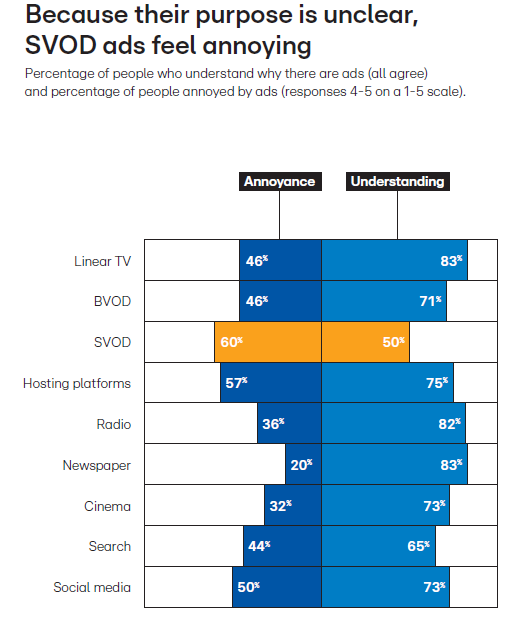
However, the research found that European viewers often do not understand why ads appear on paid video platforms, which leads to higher levels of irritation. When the purpose of advertising is not clear, people’s willingness to accept it decreases: 60% of Europeans say that ads on paid services bother them, which is 14 percentage points more than for services operated by television broadcasters, where the role of advertising is easier to understand. At the same time, the better viewers understand the purpose of advertising, the more accepting they are of it. After all, advertising funds the content they watch, helps make it accessible, and supports the creation of high-quality programming. If this principle is not explained sufficiently, negative perceptions of advertising increase, as does viewers’ overall annoyance. Linear television performs best in this respect, with 83% of viewers understanding the role of advertising.
Traditional media enjoy viewers’ trust
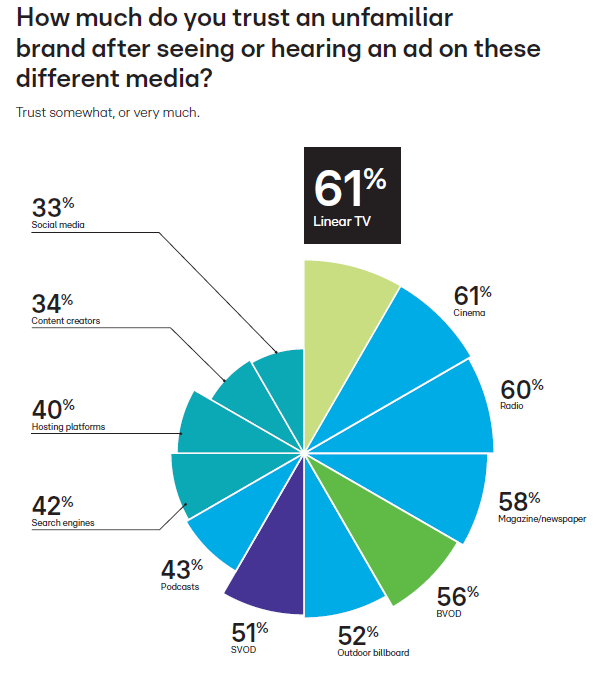
European viewers continue to place the greatest trust in traditional media. Linear television has a trust level of 61%, radio 60% and print 58%, while broadcasters’ online services also hold a strong position at 56%. These media are perceived as established, regulated and reliable in terms of content.
By contrast, trust declines in more open digital platforms, such as online video platforms (40%) and social networks (33%), where content is subject to less control. The findings show that a more trusted environment also has a significant impact on how viewers perceive brands and advertising.
The bottom line
The comparison between Europe, the United States and China reveals a distinctive media ecosystem shaped by decades of local broadcasting, the availability of free-to-air channels, and strong cultural proximity. Europeans use global streaming platforms primarily for on-demand content, while live events, local programming and shared viewing experiences remain closely tied to linear television. According to the study, an environment based on trust, stability and a loyal audience that arrives and stays cannot simply be created through scale or investment alone. Nearly two thirds of respondents (61%) say they trust linear television the most when watching advertising, significantly more than social media (33%) or online video platforms (40%).
At the same time, audiences are increasingly aware of the growing fragmentation of the video landscape: viewers are spread across different platforms, their attention spans are shrinking, and long-form formats are being broken up into shorter pieces of content. This development is visible across markets, but in Europe, the strong position of traditional television viewing, long-form content and the shared viewing experience remains evident. The findings also suggest that social media are losing their ability to create genuine interpersonal connections — 73.6% of Europeans and 72.2% of respondents in the United States believe this to be the case, among the highest figures recorded in the regions surveyed.
Source: rtl-adalliance.com