

The new study highlights the importance of music, a topic long recognised in the advertising industry. Yet when it comes to budgets and numbers, few can convincingly justify higher investment in an ad’s soundtrack. Music is one of the most powerful forces for boosting advertising effectiveness, yet it remains a consistently underestimated element.
The authors of the study Sound Science: How Music is the Missing Link in Marketing ROI, conducted by MassiveMusic in collaboration with the Institute of Practitioners in Advertising (IPA) and research partners, start from a simple yet fundamental question: if music can evoke strong emotions, can it also demonstrably boost business performance? The answer is unequivocal: yes.
Music unlocks the door to emotions, yet remains undervalued
Music is one of the fastest pathways to human response. People react to sound 17% faster than to visual stimuli. In this way, music precedes the image and opens the door to our emotions. And it is precisely these emotions that are a key factor in effective advertising. When music is well chosen and aligns with the brand, it increases message comprehension by 13% while enhancing creativity, empathy, and emotional engagement.
The authors of the study also draw on earlier research. For example, according to Ipsos data, sound is the strongest brand asset overall – it can generate up to 8.5 times more attention than other brand assets. An analysis by System1 also shows that audio elements can increase brand awareness by 191%, more than other types of brand assets. Despite this, the use of music and sound among brands remains relatively low. In other words, the potential is enormous, but it is still far from fully utilised.
The study builds on a long tradition of research into advertising effectiveness. As early as 2013, Les Binet and Daniel Müllensiefen demonstrated (based on data from the IPA database) that music in television advertising is associated with better business effectiveness. They found that campaigns using music showed 20–30% higher effectiveness, and that the right choice of music could further boost an ad’s performance by another 10–30%. However, the data available at the time did not allow researchers to reliably distinguish between short-term and long-term effects.
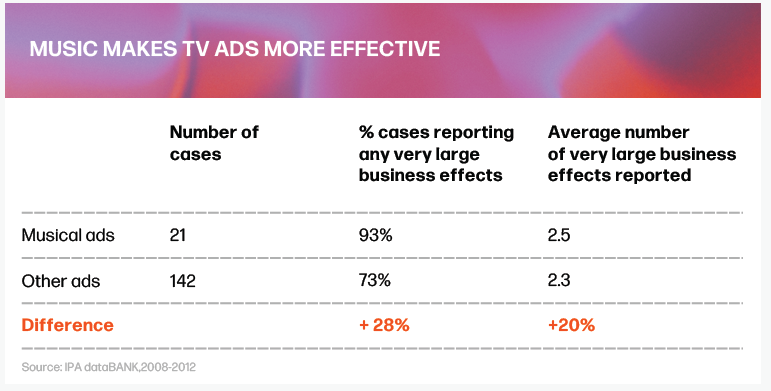
The new research directly links the choice of music with business results - both immediate and long-term. The researchers analysed 150 television campaigns from 2016 to 2024 and connected viewers’ responses to the music with data on actual business effectiveness.
Their goal was to give marketers and creatives firmer ground to stand on. It is not enough to simply claim that music “works”; it is necessary to clearly show when, how, and why it works. Above all, the aim is to demonstrate how music can help ensure that advertising not only feels appealing but also delivers a real business impact.
Music that captures attention leads to a higher return on investment
Music in advertising is not just background decoration. Research shows that it can significantly influence how much money a campaign generates, how strong a position the brand gains, and how willing people are to pay a higher price. Four key qualities of music are crucial: whether it captures attention, whether it fits the visuals, whether it surprises, and whether people remember it.
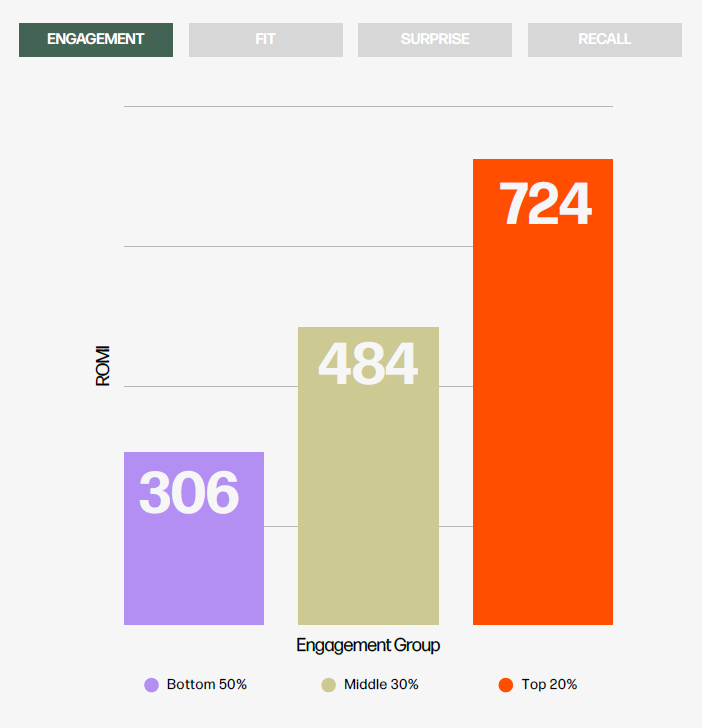
The strongest and most direct relationship was found between the level of engagement with the music and the return on marketing investment. The more the music draws listeners in and emotionally resonates with them, the higher the commercial effectiveness of the campaign tends to be. Among campaigns in the lower half of the ranking, the return index reached 306. In the middle group, it rose to 484. However, among the top fifth of campaigns, the value climbed as high as 724. By comparison, the average campaign has a value of 100. Music that truly captured attention therefore delivered more than seven times the return compared with the average.
Source: Sound Science
When the music fits, consumers are willing to pay more
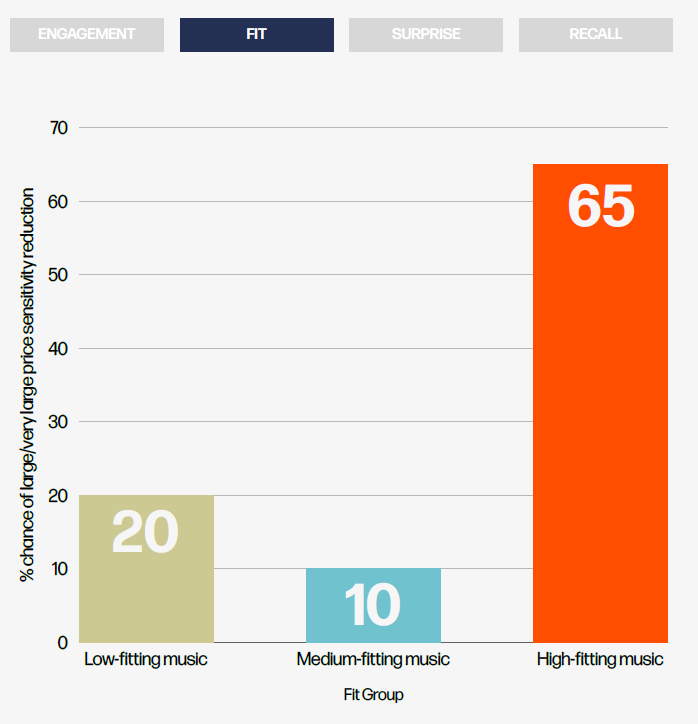
Another key attribute is the alignment of the music with the visuals and the brand. It is not enough for the music to be simply pleasant - it must support the meaning and tone of the advertisement. The research showed that higher alignment reduces price sensitivity. The analysis confirmed both a linear and an amplifying effect. When the music truly supports the visuals and the brand, customers can be up to seven times more willing to accept a higher price.
 Source: Sound Science
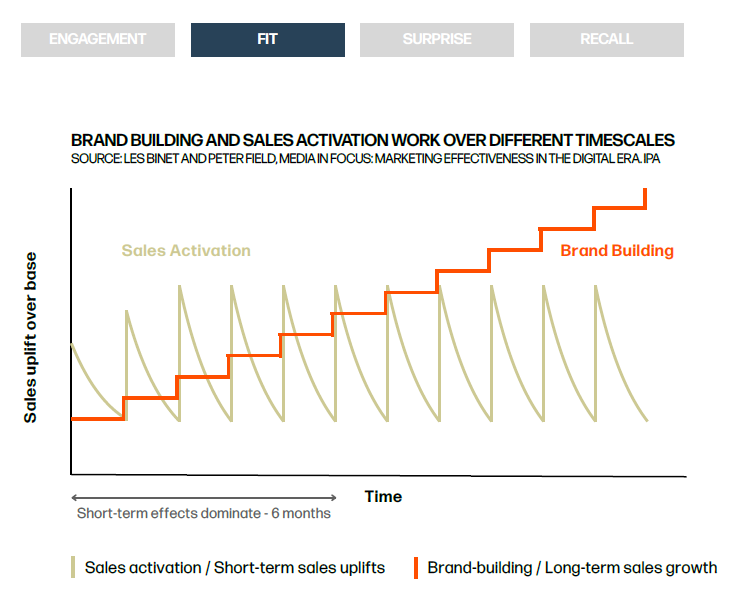
Moreover, the effect of choosing the right music increases over time. If a brand uses suitable music consistently over the long term, people strongly associate it with the brand, which gradually strengthens its pricing power.
 Source: Sound Science
There is, however, one caveat: too much perfection can be harmful. Music that fits “perfectly” can sometimes feel less distinctive and stand out less, which may reduce the ad’s noticeability. The ideal solution is therefore to find a balance between suitability and originality.
The element of surprise is also important
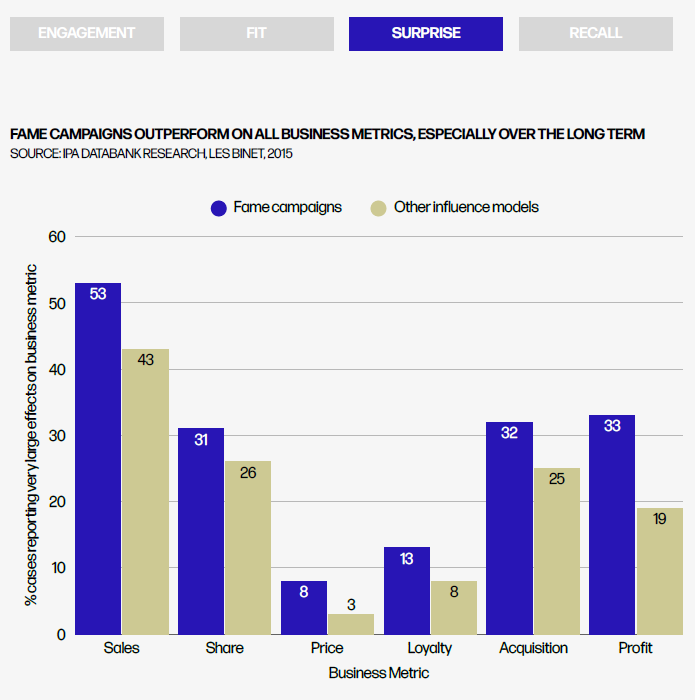
Breaking through the “advertising noise” in today’s saturated media environment is no easy task. Surprising music, however, can achieve this. The human brain reacts more strongly to stimuli that disrupt expectations. The analysis showed a positive relationship between the level of surprise and the campaign’s impact. Ads with highly surprising music were up to five times more likely to generate an exceptionally strong cultural impact. This prominence or fame significantly translates into business results.
 Source: Sound Science
The differences are evident across various business metrics:
- sales: 53% vs 43%,
- share: 31% vs 26%,
- price: 8% vs 3%,
- loyalty: 13% vs 8 %,
- acquisition: 32% vs 25%,
- profit: 33% vs 19%.
Surprise and distinctiveness are therefore not just a media effect - they are also linked to a higher likelihood of better business outcomes.
Memorability of music enhances a brand’s mental availability
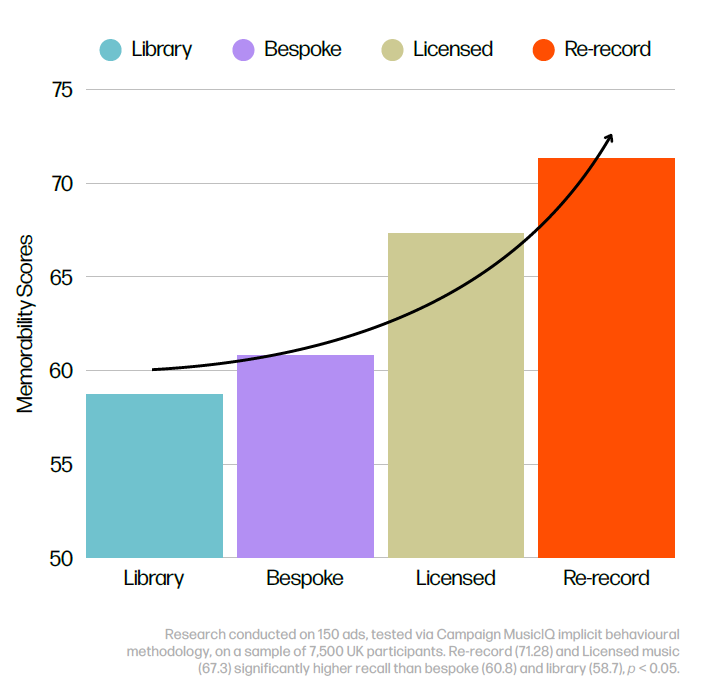
The study’s results further show that the memorability of music directly affects whether people recall the brand in a purchasing situation. Highly memorable music can increase the brand’s mental availability by up to 4 times.
The research team also compared different sources of music in terms of memorability. The best-performing were re-recorded familiar tracks (memorability score averaging 71.28) and licensed music (67.3). Bespoke music averaged 60.8, and music from standard stock libraries 58.7. It is therefore clear that a combination of a familiar motif with a new arrangement has a stronger impact than entirely new or anonymous music.
 Source: Sound Science
In summary
The study’s results show that music in advertising is not merely an aesthetic addition but a strategic decision with a direct business impact. For a campaign to truly succeed, it is not enough for the music to be “inaudible” or just pleasantly complement the visuals. It must serve a specific role. The study summarises the key characteristics that form the recipe for a strong and effective campaign:
- The key is the ability to capture attention and evoke emotion. When music draws the listener in, it increases the effectiveness of the entire campaign. Music that makes a strong impact can double the return on marketing investment. Without engagement, a deeper connection with the brand fails to develop, and the ad remains just one of many stimuli.
- Alignment between music, visuals and the brand creates a sense that everything “fits together.” Such harmony increases the perceived value of the product and reduces customers’ price sensitivity. The study’s results suggest that strong alignment can increase the likelihood of significantly lowering price sensitivity by up to seven times.
- The long-term dimension is also important. When a brand uses music consistently, it gradually becomes a recognisable element of the brand. The connection between the music and the brand strengthens, along with the brand’s ability to maintain a higher price. In other words, the right music is not just a creative decision - it is an investment in future pricing power.
- Boldness pays off. A surprising choice of music can make an ad stand out from the average. Such ads have a multiple times higher chance of achieving “fame.” In the long term, this distinctiveness is often the key to growth. Campaigns that reach high levels of fame more frequently show strong business results across metrics - from sales to profit. Surprise can evolve into uniqueness over time. Music that was initially unexpected, when used consistently, becomes a recognisable brand symbol. What started as a bold move can transform into a powerful brand asset.
- If people remember the music, they remember the brand. Memorable music significantly increases the likelihood that a consumer will recall the brand at the point of purchase. An interesting finding is that re-records of famous music perform particularly well, as they combine a sense of familiarity with novelty, creating a stronger memory imprint than entirely new or anonymous music.
Music simply contributes to building a brand step by step. However, it is not enough to fulfil just one of the desirable characteristics; the optimal approach is to satisfy them all. Brands that succeed in doing so will hold a magic wand that helps them create not only a powerful creative experience but also a tool for achieving real business success.
Source: massivemusic.com