

Growth and comfort do not coexist, said American executive Ginni Rometty years ago. That statement fits today perfectly. Among the acute challenges of the current marketing environment are high media fragmentation, pressure for short-term ROI, and increasing consumer uncertainty. Brands are finding it increasingly difficult to succeed in this stressful environment because they must meet immediate performance goals while maintaining long-term relevance, trust, and recognition in the eyes of consumers. For this reason, in 2025, Thinkbox continued its research tradition to provide data showing what truly works in advertising over the long term. While individual studies focus on different topics – brands, effectiveness, media planning, trust, or the duration of advertising impact – together they present a consistent picture: in today’s unstable world, the most valuable assets are those built systematically over time.
A brand as a source of value in an era of uncertainty
The question of the significance of brands in today’s volatile and uncertain world was examined in the project From Brand to Bland 2. The findings are clear: brands give people a sense of quality, certainty, and emotional connection, acting as reference points in everyday decision-making. Products stripped of their branding are perceived by consumers as lower quality, even though they have not undergone any actual changes. Brands support fundamental human needs, contribute to identity formation, and create long-term, sometimes even personal, bonds rooted in tradition and experience. Essentially, they serve as psychological anchors that help people navigate the world.
Advertising plays a crucial role in this process – it ensures the mental availability of brands while helping them remain culturally relevant. The study further confirms that television is a key medium for creating and maintaining these deep associations, not least because of the high level of trust audiences place in TV. And although consumers make more cautious decisions during times of economic uncertainty, they are still willing to pay a premium for strong brands and the value they deliver.
Media Mix Navigator: From Theory to Practical Decision-Making
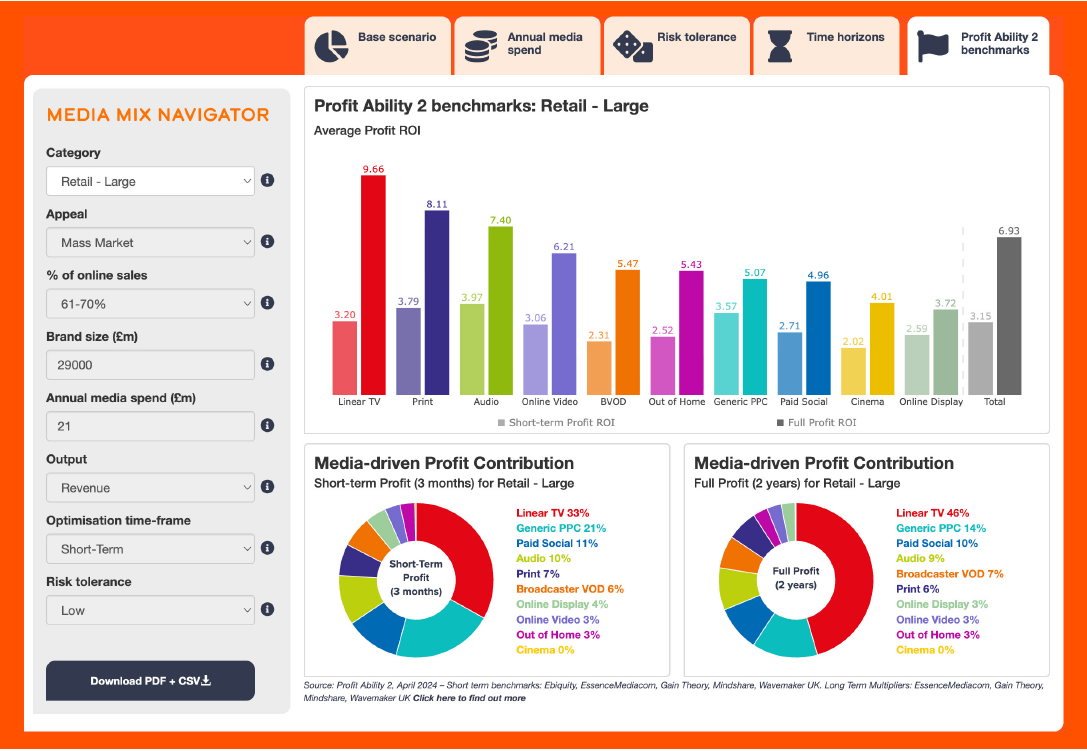
The Media Mix Navigator from Thinkbox is essentially research in practice. It is a free tool that allows any advertiser, regardless of size or IT skills, to optimise their channel mix with respect to return on investment, growth ambitions, and risk appetite. The tool works with the Profit Ability 2 database, which includes three years of econometric analyses of 141 brands across 14 categories and 10 media channels, with a total investment volume of £1.8 billion.
 Source: Thinkbox.tv
From the chart above, which is an output of Media Mix Navigator, the differing contributions of media to short-term profit (3 months) versus long-term profit (2 years) are immediately apparent. Some channels deliver quick returns, but their long-term impact is quite limited. Television, on the other hand, proves to be a medium with a significant long-term effect, supporting stable growth. Media Mix Navigator allows these differences to be taken into account when planning according to specific objectives, time horizons, and risk tolerance.
How to achieve the longevity of the advertising effect
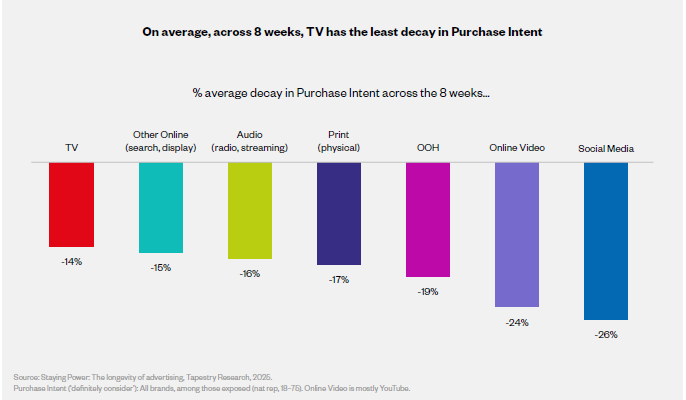
The Staying Power study focused on how long advertising influences purchase intent. The results show that not all media are equal in this respect. As illustrated in the graph below, purchase intent after exposure to TV advertising drops by only 14% over eight weeks, which is the lowest decline among all channels studied. A key factor in TV’s long-term impact is its shared nature. Watching ads on a large screen, often in the presence of others, slows the decline in effect by almost half and significantly increases ad likeability, as ads viewed in a communal setting are rated much more positively. At the opposite end of the spectrum, social media sees a decline of 26%.
 Source: Thinkbox.tv
Younger consumers are a particularly challenging group. Among people aged 18–34, purchase intent declines almost twice as fast as in older age groups, with the steepest drop seen in online video and social media. The exception is VOD, which maintains its effect significantly longer among younger viewers than other digital formats.
The Staying Power study conducted by Thinkbox revealed surprising insights about the longevity of television advertising and its unique ability to amplify the impact of other media channels. The study’s findings, such as television’s role as a “battery” that powers other media and the strong effect of shared viewing, are invaluable for shaping future campaigns.
Holly Turner, Brand Specialist, Vodafone
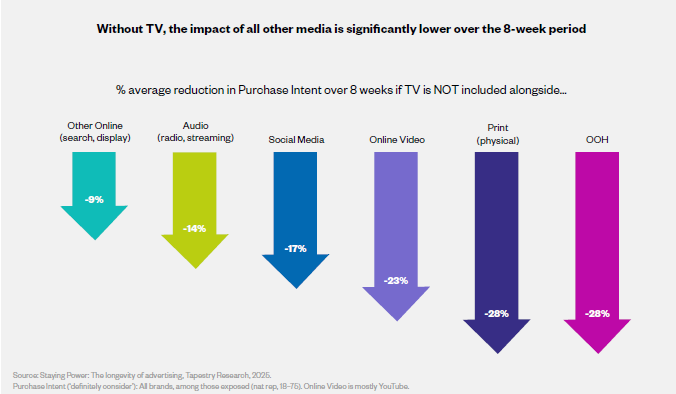
The study also shows that television acts as a multiplier for other media. When included in the media mix, it slows the decline in effectiveness for online video, print, out-of-home, and audio channels.
 Source: Thinkbox.tv
Trust as a competitive advantage
Based on data from the IPA Effectiveness Databank, WPP Brand Asset Valuator, academic research, and a new Tapestry Research survey, Thinkbox shows that trust is highly category-dependent, transfers to brands, and varies across generations.
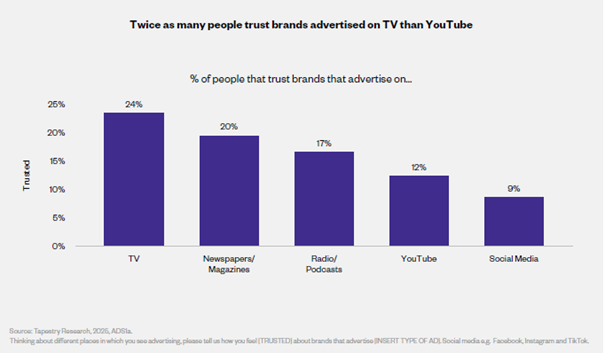
A data analysis of 1,463 brands across 145 categories shows that, in most cases, there is a strong link between trust and top-brand status, with the effect being most pronounced in areas perceived as higher risk, such as finance or charitable organisations. Trust also transfers from the media environment to the brands themselves – advertising placed in a trusted context increases brand credibility. The greatest trust-transfer effect comes from television: brands that advertise on TV are perceived as more trustworthy than in other media. Brands advertised on TV are trusted by 24% of respondents, compared with 12% on YouTube and only 9% on social media.
 Source: Thinkbox.tv
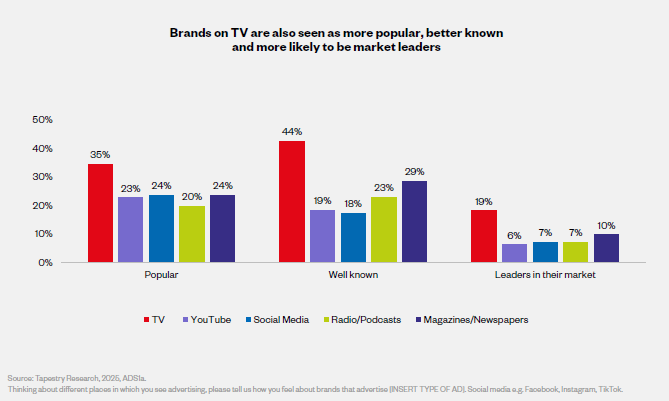
Moreover, brands that advertise on television are more often perceived as popular, well-known, and as market leaders.
 Source: Thinkbox.tv
Trust also operates differently across generations. Younger consumers under 35 generally place more trust in brands than older audiences. People over 35 tend to be more sceptical and view trust as a fundamental filter. Without it, they won’t consider a brand at all, regardless of its other attributes. For older consumers, it is therefore crucial to choose media that convey a high level of credibility and reinforce perceptions of quality and reliability.
Excluding television from the media mix is a strategic mistake
The study Why the Eff Would You Cut TV? analysed real campaigns to show what happens when television is completely removed from the media mix. The results are clear: eliminating TV significantly reduces overall campaign effectiveness, lowers profits, and undermines the performance of other media. Even if the total budget is reallocated to other channels, it doesn’t help. The absence of TV leads to an immediate drop – average profits fall by a quarter within just three months and by almost 60% in the long term.
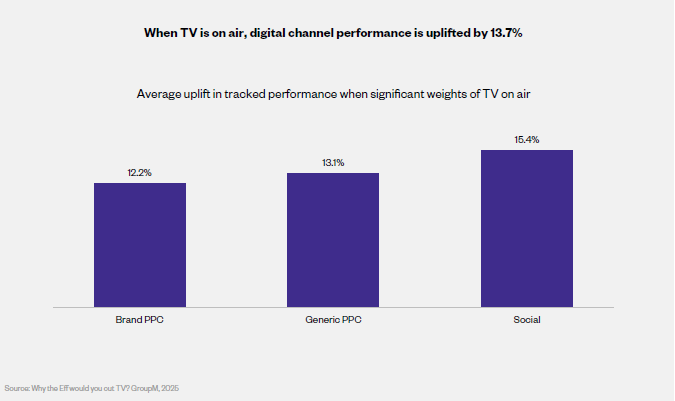
The study also shows that television doesn’t operate in isolation but boosts the performance of channels such as PPC campaigns and social media. When combined with a simultaneous TV campaign, the performance of digital channels increases by an average of 13.7%. In other words, TV strengthens the entire performance media ecosystem, and removing it weakens all other media investments.
 Source: Thinkbox.tv
We have always known the impact television has on performance metrics, but it was fascinating to see the reverse effect – what happens when TV isn’t available. For clients and agencies, it was an important reminder that when cutting budgets, we must always think strategically about the bigger picture, not just the immediate situation.
Faye Gilman, Head of Client Leadership, OMD
Key takeaways
The Nickable Studies 2025 report shows that long-term advertising effectiveness is not achieved through one-off optimisations, but through the systematic building of brands, trust, and media presence in highly credible environments. Across studies, television proves to be a medium with a unique combination of long-term impact, the ability to strengthen other channels, and the power to transfer trust to brands. In times of strong budget pressure, it should therefore be seen not as a cost, but as a key investment in sustainable growth.
Source: thinkbox.tv