

What you will find in the article:
- Television advertising evaluated by specific business outcomes, not just reach.
- Nine out of ten campaigns showed increased sales for consumer goods.
- Over two-thirds of campaigns led to increased visits to physical locations.
- Linking advertising exposure to consumer response improves future targeting.
- Television and digital media can be measured using similar metrics.
The study’s findings highlight a general trend that is also relevant to Czech advertisers: television advertising no longer needs to be evaluated solely based on viewing figures and the number of people reached. By linking the appropriate data, it is also possible to examine whether people exposed to a campaign were genuinely more likely to make a purchase or visit the advertised location.
From viewing figures to actual outcomes
As part of its research, Environics Analytics compared the results of a group exposed to a television campaign with those of a similar group not exposed to it. The company linked television exposure data with information about retail purchases and mobile location data that made it possible to track visits to physical locations.
The analysis did not focus solely on traditional media metrics such as reach or the number of advertising contacts. It also examined incremental sales, increases in conversions and customer numbers, and changes in visits to restaurants and shops. Audience profiling was another component of the study, intended to identify the consumer groups that responded most strongly to individual campaigns.
This approach helps bring television closer to the way advertisers commonly evaluate digital advertising. Instead of asking only how many people saw a commercial, it is also possible to investigate whether the campaign increased the number of purchasers, the likelihood of a purchase or incremental revenue.
Television campaigns translated into sales
In the sales section of the analysis, nine out of ten campaigns for packaged consumer goods brands recorded an increase in sales. The average incremental sales lift was 19%, the average incremental conversion lift was 8%, and the average increase in the number of purchasers was 7%.
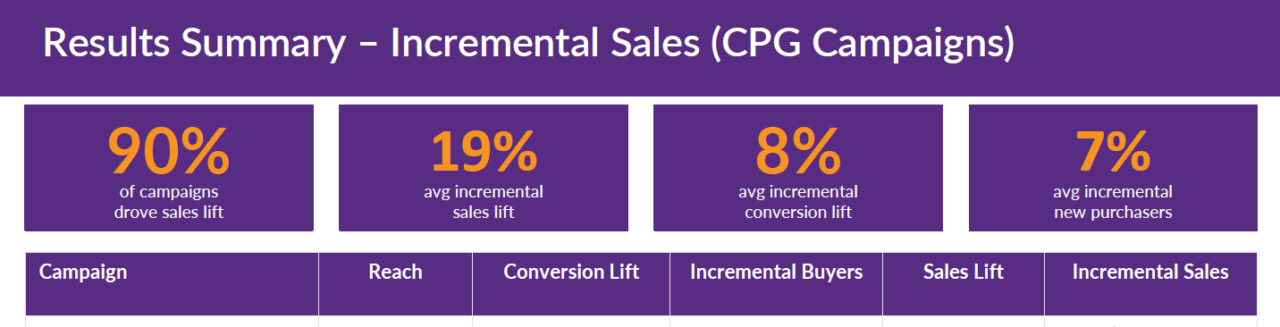 Results from a selected group of Canadian television campaigns for packaged consumer goods brands. The study examined short-term changes in sales, conversions and the number of new purchasers; Source: Environics Analytics, TV Outcomes, 2026.
Naturally, these figures do not mean that every television campaign will automatically deliver the same result. Outcomes varied considerably between individual campaigns. The study’s authors point out that reliable evaluation requires a clearly defined period, a sufficient number of impressions, a specific call to action and a sufficiently large data sample. The overall results nevertheless indicate that television advertising does not have to influence brand awareness alone. Its effects may also be reflected in immediate purchasing behaviour.
The proportion of campaigns in which a positive change was recorded is particularly important. This was not simply one exceptionally successful campaign that substantially increased the average, but a recurring result seen across most of the campaigns examined.
Television can also bring people into physical locations
The part of the study focusing on visits to physical shops and other premises produced a similar picture. More than two-thirds of the campaigns analysed recorded a short-term increase in visits to physical locations. Positive results were observed for restaurants, retailers, pharmacies and grocery shops. Although the findings varied according to the brand and type of offer, positive changes appeared across several different categories.

For advertisers with physical branches, this represents an important development. The impact of a television campaign can be assessed not only through surveys of brand awareness or stated purchase intentions, but also by examining whether the number of actual visitors changed after the advertisement was broadcast.
However, this type of evaluation requires high-quality data and a carefully designed methodology. The fact that a campaign coincides with an increase in visits does not in itself prove that the campaign caused the increase. Results may also be affected by seasonal fluctuations, prices, weather, competitor activity or other communication channels. It is therefore important to use an appropriate comparison group and take the wider context of the campaign into account.
More accurate measurement helps improve future campaigns
The value of this type of analysis does not lie solely in subsequently confirming that a particular campaign worked. Linking broadcast advertising with business outcomes can help identify which audience segments responded most strongly, allowing future targeting, offers or messages to be adjusted accordingly. For campaigns to be evaluated reliably, it is necessary to define the campaign period clearly, ensure a sufficient number of advertising contacts and determine in advance what response the communication is intended to generate.
It is also important not to focus on just one campaign. Comparing multiple campaigns can reveal recurring patterns, such as which audience segments respond most strongly, which types of offers are effective and how future investment can be planned more precisely. A single campaign shows what happened in a particular case, but analysing multiple campaigns can provide a more reliable basis for further optimisation.
Television and digital do not have to be opposed
The study’s authors state that television and digital media do not have to be evaluated according to entirely different rules. More accurate measurement makes it possible to link exposure to television advertising with a specific consumer response and assess it using the same business metrics that advertisers monitor in online campaigns.
This does not mean, however, that all media channels can be compared using a single figure. Alongside short-term business outcomes, television can also perform brand-building functions. This particular analysis focused primarily on the short-term effect of campaigns on sales, conversions, the number of purchasers and visits to physical locations. Its main conclusion is not that television advertising will always increase sales by a particular percentage in every situation. More importantly, when suitable data is available, its commercial impact can be measured much more specifically than before. Television can therefore be planned not only as a medium that delivers broad reach, but also as a channel that makes a measurable contribution to sales, customer numbers and visits to physical locations.
Source: thinktv.ca