

What you will find in the article
- Advertisers can often increase media investment profitably, up to a saturation point
- Reallocating existing budgets could boost annual profit contribution by 9.3%
- The modeled optimal media mix increases Total TV’s budget share to nearly 65%
- TV generates substantial profit beyond the campaign and within the first year
Spending More Pays Off – Up to a Point
It is hardly surprising that greater investment in advertising can lead to higher profits. But how much additional spending remains profitable? An excessive focus on ROI can lead advertisers to restrict their budgets, even when further investment would generate additional profit. At the same time, the return on each additional pound invested gradually diminishes, until increasing the budget further is no longer worthwhile.
For The Growth Gap study, WPP Media UK used its Media Mix Navigator to analyse 7,488 scenarios covering 624 brands across twelve different budget levels. The calculations are based on UK market data and build on the econometric findings of Profit Ability 2, which Screenforce has previously covered.
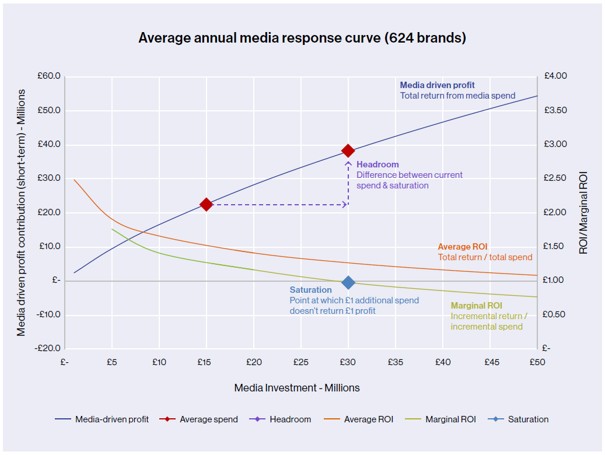
The analysis found that the average advertiser in the study spends approximately £15 million a year on media, while the saturation point averages around £30 million. Up to this point, every additional pound invested still generates at least £1 in profit contribution. The chart below illustrates how increasing advertising investment can generate greater total profit even as average ROI declines. The purple dotted line highlights the headroom between the current average media budget (the red diamond on the left) and the saturation point (the blue diamond). The red diamond on the right shows the total profit contribution at this higher level of investment.
The scope for profitable increases in advertising spend varies considerably by sector. According to the research, it is substantially greater in travel and retail than in sectors such as financial services and telecommunications.
The researchers estimate that UK businesses are collectively missing out on £32 billion in potential profit growth by underinvesting in media.
Greater Profits Without a Bigger Budget
But what if increasing the advertising budget is not an option? According to the research, there is another way to generate greater profits: changing how the existing budget is allocated across media channels.
In practice, channels that deliver quickly measurable results, such as search and social media, often attract a disproportionate share of attention. Yet the channels that deliver the fastest returns are not necessarily those that generate the greatest profit over a full financial year.
WPP Media UK therefore modelled how a £15 million media budget could be optimally allocated to maximise profit contribution within the same financial year. The results differ substantially from the current average allocation.
In the optimised media mix, the share allocated to Total TV, comprising linear television and broadcaster video on demand (BVOD), rises from 44% to almost 65%, as shown in the chart below.
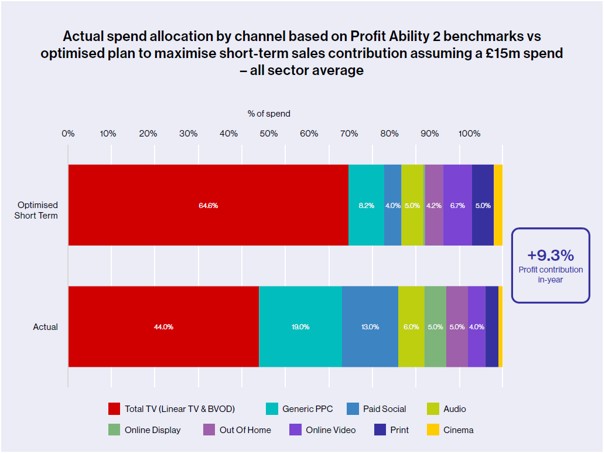
By contrast, the combined share of paid social and generic paid search falls from 32% to just over 12%.
According to the calculations, this reallocation would increase profit contribution within the financial year by 9.3%, without any increase in the overall media budget.
Long-Term Advertising Effects Start Delivering Today
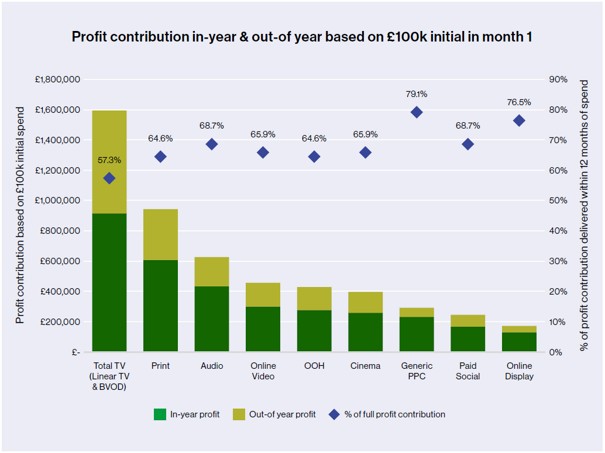
A key part of the explanation lies in how advertising effects develop over time. Channels such as television do more than drive short-term sales: they also generate effects that continue to deliver results over a longer period. Although these are often regarded as long-term returns, they actually begin to accrue while a campaign is still running. According to the research, 57% of TV's total profit contribution is realised within twelve months. For generic paid search, the figure is approximately 79%. However, that higher percentage does not mean search advertising generates more profit in absolute terms. As the chart below illustrates, given the same initial investment of £100,000, TV generates substantially greater profit contribution than generic paid search, both within the first twelve months and beyond.
The timing of media investment can also make a difference. For advertisers focused heavily on annual financial results, the researchers suggest that it may be beneficial to invest in media with longer-lasting effects earlier in the financial year. This allows a greater proportion of the resulting profit contribution to be captured within the same reporting period. Of course, the optimal timing also depends on other factors, including seasonality and campaign objectives.
Greater Profits Don't Always Require a Bigger Budget
The Growth Gap demonstrates that many advertisers still have room to increase their advertising investment profitably, although that potential is not unlimited. Equally important is the finding that higher budgets are not always necessary to generate greater profits.
Even when advertisers focus solely on profit contribution within the current financial year, the calculations suggest that a different media mix can deliver substantially better results. In particular, the findings point to a much greater role for Total TV than its share of current average media budgets would suggest. The key question, then, is not simply how much advertisers spend, but how they allocate the budgets they already have.
This article is a Screenforce summary of The Growth Gap, a study conducted by WPP Media UK on behalf of Thinkbox. The full research report is available on the Thinkbox website.
Source: scrennforce.nl