

What you will find in the article
- GTA VI’s release became a global marketing opportunity for brands.
- Rockstar combined trailers, advertising, partnerships, and real-world promotions.
- KitKat used a humorous police chase to reinforce its “Have a break” platform.
- DHL turned a delivery into a video game-inspired mission.
When Grand Theft Auto VI (GTA VI) was released on 19 November 2026, it was more than just another major launch in the gaming industry. Thirteen years after the previous instalment, the game's release became a global cultural event, attracting the attention of not only gamers but also the media, marketers and brands across industries.
Figures published ahead of the game's release already indicated the scale of public interest. The first GTA VI trailer attracted more than 93 million views on YouTube within 24 hours. According to figures from Take-Two Interactive, the second trailer generated more than 475 million views across platforms in a single day.
The game's popularity also created opportunities for companies with little connection to the gaming industry. Brands began drawing on GTA's distinctive aesthetic, in-game missions, police chases, ironic humour and fans' lengthy wait for the next instalment in the franchise.
While some responded with simple social media posts, others developed elaborate video commercials, interactive campaigns or real-world marketing events. Most of these activities were created without an official partnership with Rockstar Games.
What do the most interesting campaigns have in common? And to what extent do they incorporate the principles that advertising effectiveness research has consistently identified as important – humour, emotion, storytelling and brand recognisability?
Rockstar Games: When an Advertising Campaign Becomes a Cultural Event
In promoting GTA VI, Rockstar Games adopted a strategy that combined cinematic trailers, television advertising, out-of-home communications, music and brand partnerships.
Rather than releasing a continuous stream of new content, the publisher focused on a series of carefully timed moments. Each new trailer became a media event in its own right, amplified by fans, influencers and news outlets.
Video played a significant role. Alongside conventional trailers, Rockstar produced a more extensive showcase of the game's world, An Extended Look, which premiered on Netflix, followed by an October launch trailer. Shorter versions of the latter subsequently appeared in television advertising breaks, including, in the UK, during half-time of the Spain versus England football match broadcast on ITV.
However, the campaign extended beyond screens. Miami, the city that inspired the fictional Vice City, became one of its main settings. Promotional activities reached city streets, airports and sports arenas. Rockstar partnered with the Miami Heat basketball team, which organised a special Vice City-themed game.
From a marketing strategy perspective, what matters is that Rockstar was not simply seeking to reach gamers. Through sport, fashion, music and mainstream media, it introduced its brand to audiences that would probably not engage with conventional video game advertising.
Rockstar therefore did more than create a campaign for a new product. It established a cultural context that other brands began to use in their own communications.
KitKat: A Police Chase with a Chocolate-Fuelled Twist
One of the most striking examples of brands incorporating the theme into video advertising comes from KitKat. The brand created a short, action-packed story inspired by the world of GTA, in which police cars pursue a KitKat delivery van.
The video gradually shifts from a car chase to a humorous resolution. A character attempting to reach the van hits their head against a streetlight and loses consciousness. When the doors of the van, which is filled with chocolate bars, open, the character wakes up and takes a bite of a KitKat. The word “rested” appears on screen.
The brand thus connects the gaming atmosphere with its long-established “Have a break” communications platform.
The advertisement incorporates several classic creative principles. It features a simple narrative, drama, surprise and humour. Most importantly, however, its ending redirects attention from GTA to the product itself.
This is an important distinction from campaigns that merely adopt the visual style of a popular video game. KitKat borrows GTA's setting and narrative language, but the punchline belongs to the brand.
The video was followed by an activation on TikTok, where users could try a game-inspired filter centred on the theme of taking a break.
DHL: When an Everyday Delivery Becomes a Gaming Mission
Logistics company DHL Express took a different approach. In a short Instagram video, the company featured a courier navigating a video game-inspired environment while completing a delivery mission.
The visual style references the gaming world, with the camera following the main protagonist and transforming an everyday service into a task that must be successfully completed.
Unlike KitKat, the campaign does not rely primarily on an unexpected twist. Instead, DHL draws on the principle of gamification and the audience's ability to recognise a familiar gaming format.
The connection to the brand itself is also natural. Delivery forms the central narrative rather than serving merely as an addition to a popular cultural reference.
From a long-term advertising effectiveness perspective, this connection may be particularly important. While viewers recognise the reference to GTA, they are also following a story in which the delivery service itself plays the leading role.
Budgy Smuggler: GTA Takes to the Streets of an Australian Town
Australian swimwear brand Budgy Smuggler demonstrated that themed video advertising does not necessarily require large-scale production or expensive visual effects.
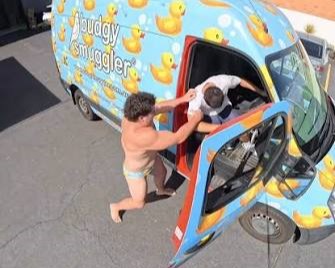
In a series of short videos, one of its employees transformed into a GTA protagonist. Wearing the brand's signature swimwear, he walks through the streets of Manly, Australia, rides away on a bicycle, collects in-game money and purchases the brand's products.
The videos feature shots resembling an in-game camera perspective, a graphical user interface and a final notification announcing the successful completion of a mission.
The result is a simple comedic format that relies primarily on the contrast between the dramatic world of an action video game and the mundane nature of everyday situations.
Budgy Smuggler therefore employs a different kind of humour from KitKat. While KitKat creates a stylised advertising narrative with a product-focused punchline, the Australian brand relies on parody and deliberately absurd situations.
This approach may be particularly appealing to smaller brands. It does not require extensive production resources, but it does demand an understanding of the target audience's cultural codes and the ability to translate them into the brand's own communications style.
KFC and Specsavers: Humour Can Work Without a Conventional Commercial
Not all prominent activations surrounding GTA VI took the form of video advertising. Some brands chose to focus primarily on public relations, social media and real-world events.
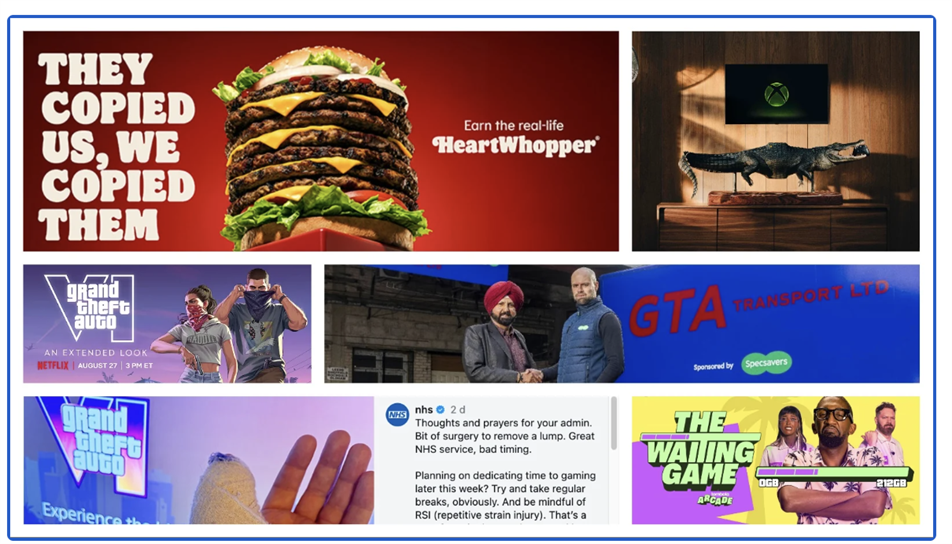
KFC Australia, for example, staged a mock funeral for a fictional person named Ann Alibi. The aim was to give GTA fans an excuse to take the day off work on the game's release date. The event featured its own invitation, a funeral ceremony and proof of attendance. Fans and content creators took part, while the brand also linked the gaming community's enthusiasm to a free delivery offer.
Rather than focusing primarily on the game's visual aesthetic, KFC tapped into fan behaviour. It capitalised on the fact that many gamers were planning to take time off work to play GTA VI on its release day.
British optical retailer Specsavers, meanwhile, opted for wordplay. It announced a major partnership with GTA, only to reveal that it was referring not to the video game franchise but to a transport company called GTA Transport Ltd. The retailer offered eye tests to the company's drivers. The campaign built on the brand's long-established communications strategy, which uses humour and misunderstandings associated with poor eyesight.
The two activations illustrate different approaches to trendjacking. KFC tapped into the gaming community's shared experience, while Specsavers adapted a trending topic to its long-established brand identity. The Specsavers approach, in particular, demonstrates that a well-executed cultural reference does not have to compromise brand consistency. On the contrary, it can provide a fresh opportunity to reinforce a familiar advertising theme.
Humour, Emotion and Storytelling: What Do the Campaigns Have in Common?
Although the brands employ different formats, their most interesting campaigns share several characteristics.
- The first is humour, which is an integral part of the gaming franchise itself. GTA has long embraced exaggeration, satire and absurd situations. Brands therefore did not have to develop an entirely new communications language; instead, they could build on something fans already knew well.
- The second element is storytelling. The more distinctive videos go beyond mere visual references. KitKat builds its narrative around a chase and an unexpected resolution, DHL creates a delivery mission, and Budgy Smuggler brings a gaming narrative into everyday reality.
- The third common theme is emotional engagement, particularly through nostalgia and shared cultural experiences. The thirteen-year wait for the next instalment in the franchise created an audience capable of recognising even subtle references to the gaming world. Brands can therefore tap into emotions without having to build them from scratch.
- The fourth characteristic is simplicity and immediate comprehensibility. Viewers do not need to understand every aspect of GTA to appreciate a police chase, a gaming mission or a joke about taking time off work.
- The fifth characteristic, and perhaps the most important from an advertising effectiveness perspective, is the connection between the cultural reference and the brand's own identity. This is precisely where the individual campaigns differ significantly.
System1's The Cure for Dull research, previously covered by ScreenVoice, identifies storytelling, drama, melodic music, humour and consistent, recognisable brand assets as five important principles of creative advertising. The study highlights the difficulties that advertising devoid of emotion faces in capturing and maintaining viewers' attention.
Similar principles can be identified in the campaigns surrounding GTA VI. However, their presence alone does not demonstrate that the advertisements were effective. Establishing their effectiveness would require access to data such as creative testing results, brand recall or the impact on purchasing behaviour.
Trendjacking Generates Attention but Does Not Necessarily Build Brands
For marketers, one of the most interesting aspects of the current wave of interest surrounding GTA VI is the tension between immediate relevance and the long-term value of advertising.
Participating in a popular cultural conversation can quickly generate reach, engagement and media coverage for a brand. However, this does not automatically mean that consumers will remember the advertiser itself.
If the logo in an advertisement could be replaced with that of another brand without altering its narrative or punchline, the campaign may amount to little more than short-term exploitation of a trend.
Conversely, campaigns from KitKat and Specsavers demonstrate that a topical cultural reference can be integrated into a long-established brand platform. In these cases, GTA serves as a vehicle that enhances the appeal of the message rather than becoming its sole focus.
Creative effectiveness research featured on ScreenVoice has consistently raised a similar issue. A strong emotional response is important, but for advertising to build a brand, it must also be clear which brand the advertisement belongs to.
It is therefore not enough for brands simply to entertain audiences. They must also establish a sufficiently strong connection between the emotion, the advertising narrative and their product.
A Major Cultural Event, Different Marketing Outcomes
Grand Theft Auto VI demonstrates how profoundly a single cultural event can influence advertising communications across industries. Through its extensive campaign, Rockstar Games successfully brought the gaming world into mainstream media, sport, fashion and public spaces.
Other brands capitalised on the resulting attention in different ways. KitKat embraced action-driven storytelling and a product-focused punchline, DHL adapted gaming mechanics to its service, Budgy Smuggler created a low-budget parody, and KFC and Specsavers turned the game's release into humorous marketing events.
Whether these campaigns will generate long-term results alongside their short-term reach cannot yet be reliably assessed. Publicly available data does not provide comparable evidence of their commercial effectiveness.
From a creative perspective, however, one lesson is clear: the most interesting campaigns are not those that imitate GTA most faithfully, but those that succeed in using its popularity to tell their own stories.
At a time when brands compete for every second of attention, trendjacking can offer a shortcut to reaching audiences. However, humour, emotion, storytelling and brand recognisability remain essential if that attention is to retain its value long after the current cultural wave has subsided.
Poznámka k překladu a publikaci: Použil jsem britskou angličtinu (humour, capitalise, behaviour,