

What you will find in the article:
- Customer service will become the norm thanks to AI agents.
- Brands will compete for access to customers, not just for their attention.
- AI will transform the traditional customer journey and decision-making processes.
- The importance of an emotional connection with customers in the digital age.
- The personalisation paradox: more personalisation, less personal connection.
Customer experience expert Steven Van Belleghem highlighted a shift at the Brand Management conference that he believes lies ahead for the relationship between brands and customers. Until now, brands have primarily competed to capture customers’ attention. Going forward, they will be competing simply to reach them in the first place. Thanks to AI , top-class customer service will become the norm. It will be available round the clock, instantly and in the customer’s own language. “Amazing service will become the most commonplace thing in the world. It will become a commodity,” he explained.
Companies are now primarily thinking about how to utilise AI within their own businesses. For brands, however, it will be just as important to monitor how their customers begin to use it. AI can significantly reduce the time people spend searching for information and comparing offers. As an example, he cited an agent that monitors a purchased flight ticket and, if it finds a 10 per cent cheaper option, automatically arranges for the booking to be rebooked. A similar principle can be applied in other sectors. He also mentioned Facebook’s Muse app, which promises savings of up to $800 a month through contract negotiation. According to Van Belleghem, these examples show that AI can provide customers with tools that previously required time or specialist knowledge.
The new shopping funnel
AI is also transforming the traditional shopping journey. Inspiration, decision-making and the purchase itself can all take place within a single environment based on a large language model. He cited Walmart as an example, which is investing in its own chatbot, Sparky, whilst also having signed agreements with OpenAI and Google. For brands, this presents a new challenge. “It’s as if a bouncer has been placed between you and your brand,” he said. If a customer asks for a specific brand, they will get it. However, if they are simply looking for batteries, for example, the AI system may make the decision.“Over the past 20 years, your task has been to capture the customer’s attention. I think this will shift to gaining access,” he said.
In his presentation, he also outlined the three layers of the relationship between the customer and the brand, which he describes in his new book.
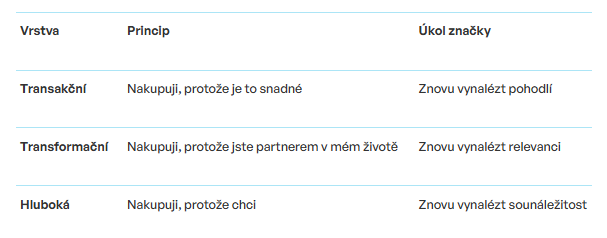
He described transactional loyalty as the most fragile. “People aren’t loyal to a brand; they’re loyal to the system behind the brand. And then they’ll switch overnight,” he said, pointing to the rapid shifts users make between AI platforms.
AI efficiency is not enough
According to Van Belleghem, 95 per cent of companies’ investments in AI are directed towards efficiency and productivity. Whilst these are important, he argues that they do not, in themselves, secure a competitive advantage for the brand. Yet customers also use AI in other ways. According to a study cited by Van Belleghem, social interaction and therapy are among the main reasons for using AI.
As examples of brands using AI, he cited L’Oréal, which offers an advisory chatbot with its own database of cosmetic data, and Mattel, which is developing an AI Barbie. HearView glasses can transcribe conversations in real time for the deaf. Ralph Lauren offers the option to consult an AI called ‘Ralph’ about outfits, whilst Duolingo is introducing conversations with AI avatars. Disney is testing the Olaf robot at Disneyland Paris. At the same time, he highlighted the need to set appropriate boundaries for such technologies, for example when used in children’s toys.
The paradox of personalisation
The conclusion of Van Belleghem’s presentation focused on the paradox of personalisation. “The more personalisation, the less personal,” he said. As an example of the opposite approach, he mentioned the American pet supplies retailer Chewy, which sends customers around a thousand oil paintings of their deceased pets every week. When he asked the audience whether they would invest $200,000 in such paintings or in Facebook adverts, around 80 per cent chose the oil paintings. Nevertheless, he argued that most companies would opt for adverts because their results are easier to measure.
“We’ve never had more technology, and we’ve never had more dissatisfied customers,” said Van Belleghem. He therefore recommended supplementing data-driven work with intuition. “Not everything that counts can be counted,” he said.
His closing message focused on the difference between technological personalisation and a genuinely personal relationship. According to Van Belleghem, AI is becoming increasingly adept at providing information and carrying out individual tasks. However, what may prove decisive for brands is the ability to evoke emotion and a sense of belonging. “We live in an age where perfect technology will compete for access to the customer. It is the connection that will make the difference,” he concluded.
Source: mediaguru.cz