

What you will find in the article:
- Austrians watch nearly six hours of video content daily.
- Traditional broadcasters account for 71% of all video consumption.
- Prime-time viewing significantly increases video consumption rates.
- Younger audiences prefer mobile and social media for video content.
- Television remains a dominant platform for advertising impact.
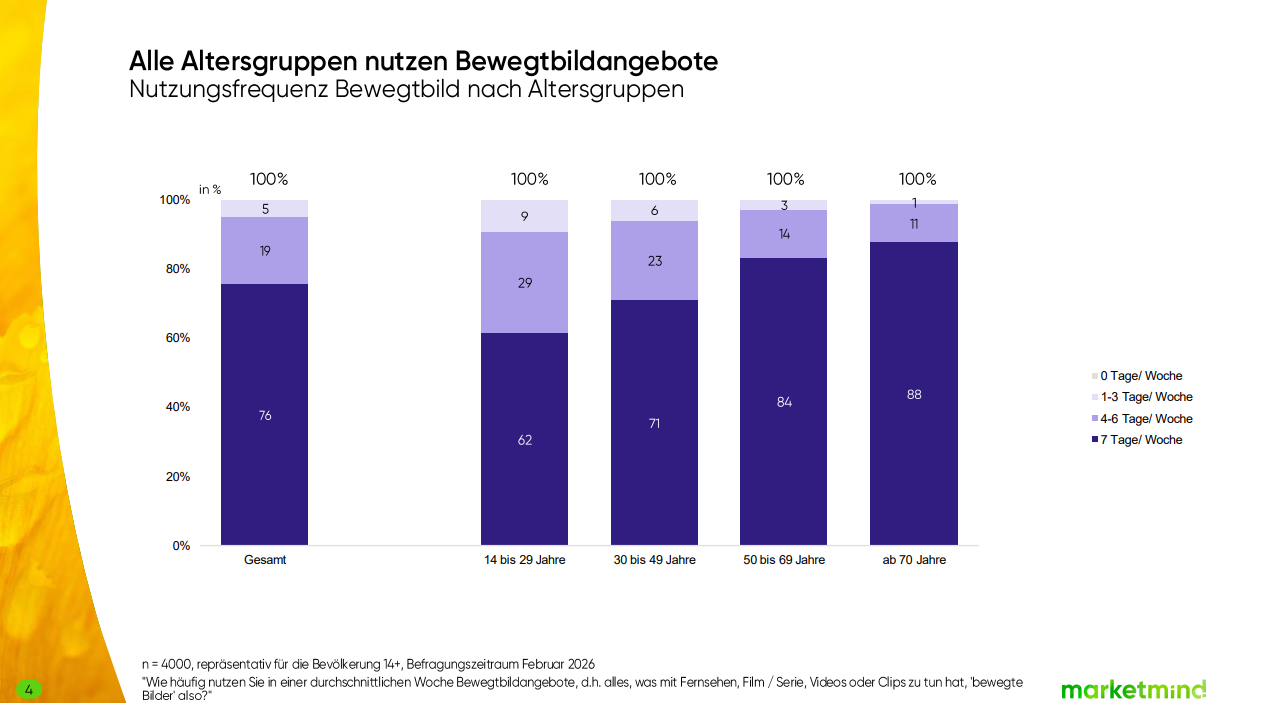
Audiovisual content is an integral part of Austrians’ everyday lives, with 100% of the population watching it at least once a week. This is the conclusion of the latest Moving Image Study 2026, commissioned by RTR Medien and Arbeitsgemeinschaft TELETEST and based on responses from 4,000 participants representative of the Austrian population. More than three quarters of the population also consume video content every day, with viewing intensity increasing with age.
 Source: Screenforce.at
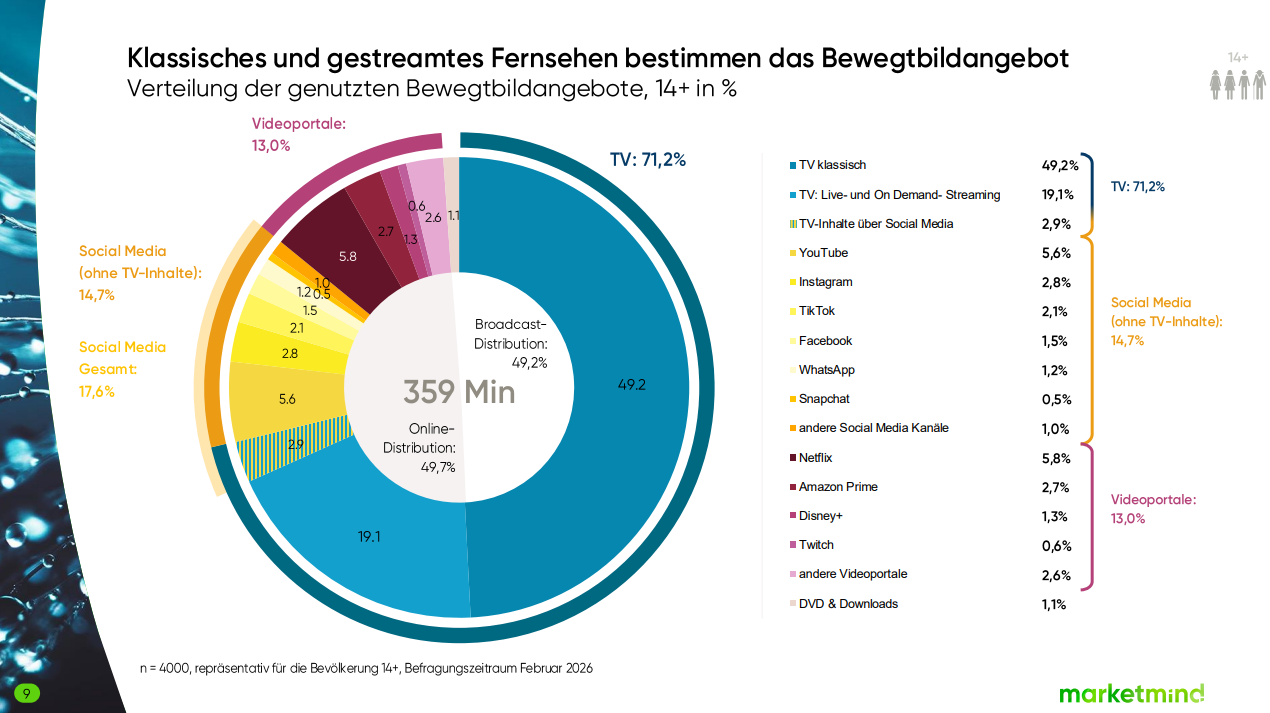
Across linear and digital distribution, traditional television broadcasters’ content accounts for a total of 71% of all audiovisual content consumed. This gives broadcasters the largest share of overall video consumption and the strongest position in people’s media lives. Video platforms account for 13%, while video content on social media, including YouTube, represents 15%, excluding content produced by television broadcasters. However, broadcasters’ programmes are also watched extensively through social media and represent the most sought-after programme brands in the highly fragmented platform environment. Today, half of all video content is consumed through traditional television distribution channels, such as cable, satellite and terrestrial television, while the other half is consumed through online channels, including broadcasters’ media libraries and their social media presence.
 Source: Screenforce.at
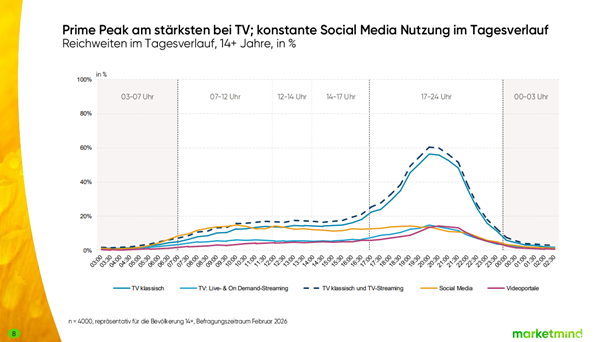
Prime-time television, traditionally beginning at 8.15 pm, remains an established part of people’s daily routines. During this period, video consumption rises significantly for both television broadcasters and streaming services such as Netflix, Prime Video and Disney+. By contrast, social media video consumption remains relatively stable throughout the day and decreases later in the evening.
 Source: Screenforce.at
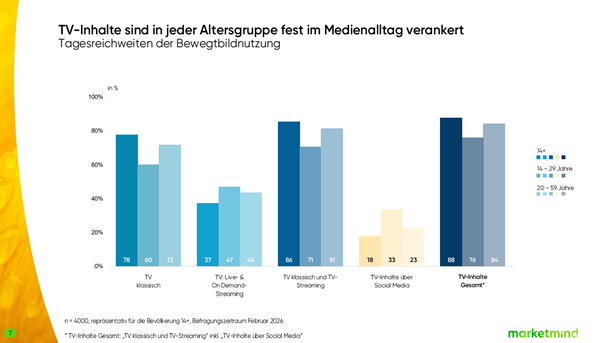
Television broadcasters remain relevant across all distribution channels, including linear broadcasting, media libraries and social media
Television is not merely a single distribution channel but a powerful ecosystem operating across multiple platforms. Digital distribution does not replace broadcasters’ content. On the contrary, it strengthens it.
 Source: Screenforce.at
Media libraries, mobile viewing and social media touchpoints are particularly important for younger target audiences, helping television content remain relevant beyond traditional linear broadcasting.
“With almost six hours of video consumption per day, viewing levels in Austria are very high. Digital distribution channels are crucial for broadcasters seeking to reach younger target audiences effectively. At the same time, the large screen retains its established role in the consumption of longer formats, while short-form videos are frequently watched on mobile devices. Television broadcasters’ content also attracts attention on social media, enabling young audiences to be directed towards established media brands and news services,” explains Wolfgang Struber, Managing Director of RTR Medien.
“Television broadcasters’ content continues to maintain its position in Austrians’ everyday media lives in digital form and can compete effectively with the platforms operated by major technology companies across all age groups. The consistent and successful development of broadcasters’ media libraries is reflected in the extensive consumption of their high-quality content across all types of devices. Screens are increasingly being used simultaneously. Second-screen use offers attractive opportunities for brands to interact with audiences, allowing them to benefit from the advertising impact of the large screen and the credibility of television broadcasters’ content, while also providing supplementary information in the digital environment,” summarises Thomas Gruber of ProSiebenSat.1 PULS 4, Chairman of Arbeitsgemeinschaft TELETEST.
Almost six hours of video content per day
Austrians spend an average of almost six hours a day watching video content, equivalent to 359 minutes. More than 70% of this time is devoted to television broadcasters’ content, including their social media content. Social media, excluding broadcasters’ content, accounts for 15%, while video platforms account for 13%, putting the two categories at similar levels. No individual platform has a share exceeding 6%. YouTube and Netflix come close to this threshold, while all other individual platforms remain below 3%.
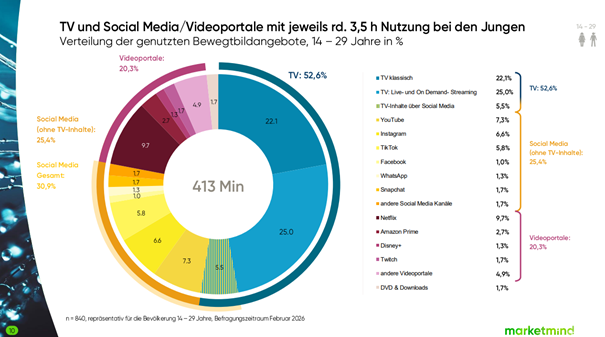
Among young people aged 14 to 29, daily video consumption amounts to 6 hours and 53 minutes, or 413 minutes. Television broadcasters’ content accounts for more than half of this viewing time, at 53%. A further quarter is spent on social media, excluding broadcasters’ content, while one fifth is devoted to video platforms. Netflix alone accounts for 10% in this age group, while the remainder of the video-platform market is highly fragmented.
 Source: Screenforce.at
The large screen remains the preferred device
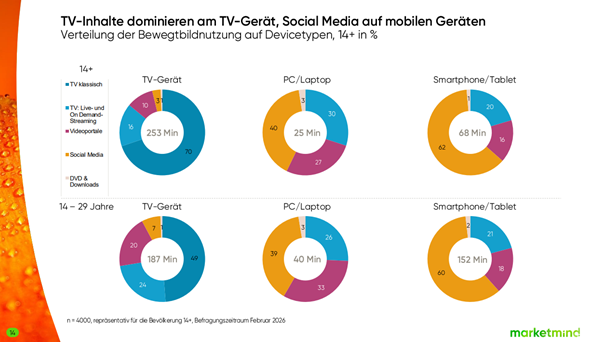
Austrians spend an average of 4 hours and 13 minutes a day, or 253 minutes, watching content on the large screen. According to available studies, this is also the device on which advertising achieves the greatest impact. Television broadcasters’ content accounts for 86% of large-screen viewing, while video platforms represent approximately one tenth of TV-set use. On smartphones and tablets, short-form social media content, including broadcasters’ content, predominates and accounts for just over 60% of mobile-device use. Broadcasters’ catch-up services rank second, with a share of one fifth, followed by conventional video platforms.
 Source: Screenforce.at
Television broadcasters’ content also dominates large-screen viewing among those aged 14 to 29, accounting for approximately three quarters of viewing. Video platforms have a 20% share of large-screen consumption, while social media ranks third at 7%. Smartphone and tablet usage patterns are approximately the same as those of the population as a whole. However, at 2 hours and 52 minutes a day, equivalent to 152 minutes, the amount of time spent watching video content on smartphones among people aged 14 to 29 is more than double the figure for the overall population.
Study methodology
The Moving Image Study 2026 was conducted by Marketmind in collaboration with Rogator, on behalf of RTR Medien and Arbeitsgemeinschaft TELETEST. In February 2026, 4,000 people aged 14 and over took part in the survey. The participants were representative of the Austrian population. Owing to a methodological innovation, the study’s results are not comparable with those from previous years. The questionnaire was specifically optimised for mobile use, enabling respondents to participate using smartphones and tablets. As a result of this technical innovation, 60% of the interviews were completed on smartphones and tablets, with the remaining 40% completed on desktops and laptops. This modernisation reflects the media-consumption habits of many target groups and increases both flexibility and reach when engaging with respondents.
The principal findings of the Moving Image Study 2026 by RTR Medien and Arbeitsgemeinschaft TELETEST are now available, together with detailed charts and tables, on the Screenforce website. The complete study is also available on the RTR Medien website.
Source: screenforce.at