

ESG campaigns – that is, advertising campaigns that communicate topics related to corporate environmental, social and governance responsibility – may, on average, attract less attention than standard advertising, but according to research by Ipsos, they can boost interest in the topic or offer being communicated.
According to Ipsos’s analysis of Czech ESG adverts from 2023–2025, ESG adverts attract less attention than other adverts (ESG adverts are noticed by 26% of Czechs on average, compared to 32% for other adverts). Conversely, in terms of interest in the content, ESG adverts outperform others (36% vs. 30%), suggesting that their strength lies not in immediate attention-grabbing but in deeper audience engagement. However, Ipsos also points out that simply communicating ESG themes is no guarantee of effectiveness. According to the research, the key lies in linking sustainability messages to the brand’s role as an active problem-solver, rather than merely shifting responsibility onto consumers.
“Brands that show what they themselves are doing achieve significantly better results than those that merely tell consumers what they should do,” explained Daniel Holátko of Ipsos. This approach achieves an effectiveness index of 108, whilst the opposite model of “what the consumer should do” achieves only 91.
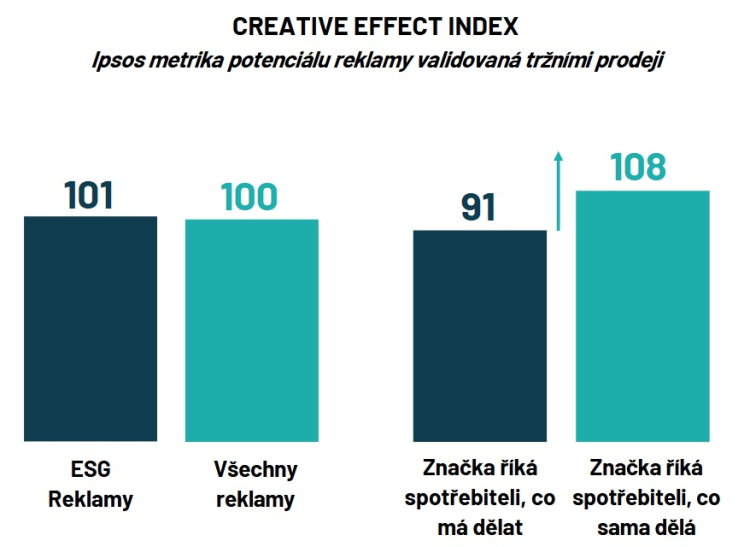 Source: Meta-analysis of the Ipsos database of tested adverts. 200 ESG adverts across 15 countries. Indices based on the Creative|Spark tool
From a creative performance perspective, ESG adverts often fall “halfway” according to Ipsos. They can deliver a powerful message and are often among the highest-rated campaigns, but their effectiveness depends on the quality of the creative execution. Examples of highly rated ESG campaigns include brands such as Air Bank ( the ‘We Help with Suspected Fraud’ campaign), Dove, Mastercard and O2.
Sustainability information: watch out for credibility
Ipsos data also shows that corporate social responsibility is a significant differentiating factor for Czech consumers, with 62% of respondents agreeing. At the same time, however, 67% of people state that they do not always considerinformation on product sustainability to be trustworthy, which creates room for scepticism towards corporate communications.
Consumers define sustainability in a fairly specific and pragmatic way. Key factors include the quality of materials, recyclability, product longevity, eco-friendly packaging, local origin and fair working conditions. Reducing waste during production and the ability to easily repair a product also play a significant role.
According to the data, experience with greenwashing is relatively low. Only 5% of Czechs have encountered false claims about sustainability. When this does occur, it most often involves food, fast fashion or cosmetics. Nevertheless , this phenomenon has a strong impact: 57% of consumers state that they would stop buying products from companies that communicate their sustainability in a misleading manner.
Sustainability works, but it is not enough on its own
Ipsos also points out that sustainability on its own is not the main driver of purchasing decisions. Consumers respond primarily to a combination of functional and emotional benefits, whilst sustainability acts as a supplementary factor that strengthens the relationship with the brand.
In the case of food and drink, claims regarding ingredients – such as the absence of antibiotics, synthetic substances or pesticides – and local origin have the greatest influence. Conversely, organic certification alone carries less weight in decision-making than might be expected.
The research also reveals a shift in sustainability communication. Whilst a societal appeal and an educational tone previously dominated, the emphasis is now shifting towards individual benefits, safety and practicality. According to Ipsos, the role of brands is thus changing from that of a ‘moralising voice’ to a provider of concrete solutions for consumers’ everyday lives.
Source: mediaguru.cz