
The ReDam project, which is the first to systematically measure out-of-home TV viewership in the Czech Republic, is entering its final phase. The expansion of the project to measure TV viewership was presented by the industry's Association of Television Organisations (ATO), the commissioner of the research, at a workshop on Thursday. The expanded data will be available from January 2026, but the ATO still wants to leave the first month of the new year for users to familiarise themselves with it. The TV viewing figures will thus be the result of a data fusion of the existing 1,900-household peoplemetre panel (PEM TV) and a newly constructed 1,000-individual "mobile" measurement panel (ReDam) from "non-television" households (i.e. households that are not part of the peoplemetre panel).
As part of the trial run, the first panel data is already being generated and data fusion tests with the existing peoplemeter project are underway. The structure of the data is identical so that the results can be merged into a single output for the market. According to the first indicative calculations, the market expects an increase in viewership of 6 to 10% depending on the target group (TRP). However, Michal Jordan, Managing Director of the ATO, points out that these are preliminary figures and only the hard data will show the actual increase.
With the advent of the ReDam project and its integration with PEM TV's people metering, a new official single currency for TV viewership will be created in 2026. This will maintain the current temporal structure of the data, i.e. live viewership and delayed viewership up to three days, while expanding it to include previously unmeasured out-of-home viewership.
The new data will be provided twice a day. Traditional peoplemetered data will be available until 8:00 am, while fused data, i.e. supplemented by the out-of-home follow-up measured by the ReDam panel, will be published until 3:00 pm. The aim is to deliver the data as quickly as possible, but at the same time with a guarantee of correct technological and methodological processing.
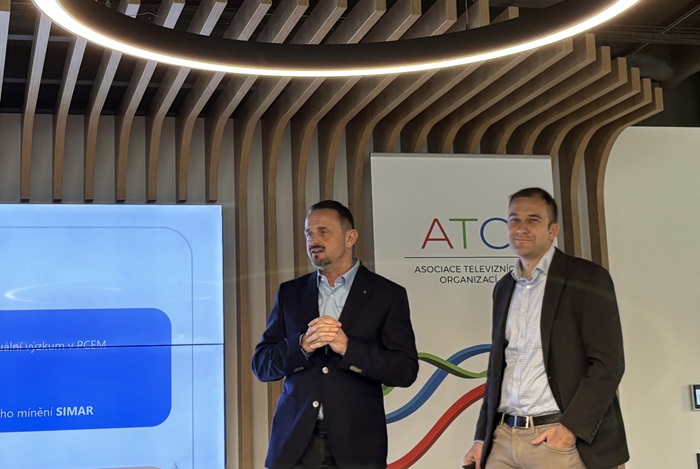 Tomáš Hynčica, director of ReSolution Group, and Jakub Fulín, client service director of ResSolution Group, at the ATO workshop; Source: Mediaguru.cz
New panel under construction since spring
ResSolution Group, the company that implements mobile measurement outside the home, reports that the panel, which began construction in the spring of this year, currently has over 900 respondents. By the end of the year, it is expected to reach the planned level of 1,000 individuals. According to Jakub Fulín, the company's client service director, recruitment is extremely time-consuming and logistically demanding. The research agency uses a combination of its own CATI studio in Jindřichův Hradec, its own interviewing network for F2F (face-to-face) collection and CAWI interviewing. Screening is done by random sampling and up to 150 operators devote more than 100 hours of net time per day. For the F2F part, selection is random and stratified using quotas and selection points.
The panel consists of individuals aged 15 , with norms set by gender, age, education, region and size of place of residence. Participants are incentivized either by a financial reward, which is chosen by the majority, or by donating a mobile phone dedicated to the project.
Compared to existing peoplemetering, the ReDam mobile out-of-home measurement differs in that:
- it uses mobile phones instead of a TV meter (peoplemeter),
- it measures on a panel of individuals (15 ) instead of households (4 ),
- and the survey takes place wherever the respondent is.
Detection is done using audio matching and technology running in the background of the phone. A mobile application records the audio footprint of TV broadcasts in the vicinity of the respondent's device and simultaneously identifies whether the respondent is at home or away from home (by combining GPS and Wi-Fi signals). In doing so, the primary residence is technically barred to accurately separate home and OOH viewership.
Measured everywhere, screen size is also differentiated
The measurement covers all places where TV broadcasts can be encountered outside the home: restaurants, pubs, squares, public screenings, sports venues, offices, cottages, but also viewing on a computer or mobile phone outside the home.
An essential feature of ReDam is also the distinction between big and small screen viewing. ResSolution Group collects data on device type by querying the app along selected viewing segments and then builds a statistical model that assigns the likelihood of viewing on a large or small screen to other segments.
A large screen is defined as a TV or large screen projection; a small screen is defined as a mobile phone, tablet or computer. Early data for November 2025 suggests that 88% of out-of-home viewing takes place on a large screen, with the remaining 12% on small devices.
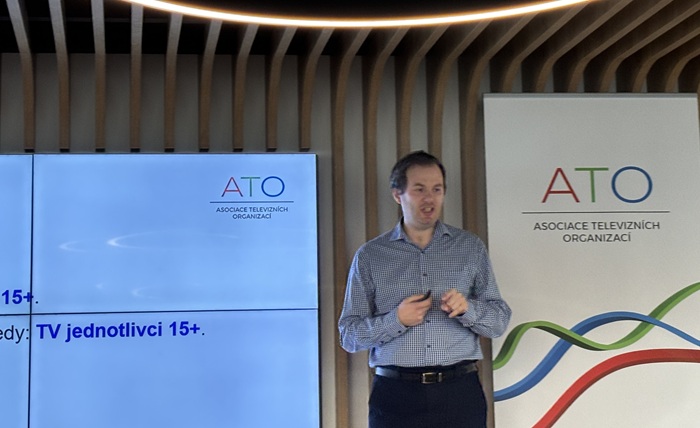 Tomáš Hanzák at the ATO workshop; Source: Mediaguru.cz
Two independent panels, one common output
PEM TV and ReDam form two distinct panels that do not overlap. One measures in-home viewership using TV meters, the other measures out-of-home viewership using mobile phones. The merger is intended to ensure that the two worlds merge into one "common" data, usable in the same tools and metrics (rating, share, GRP, target audience), described Tomas Hanzák, an analyst at research agency Nielsen, which is involved in the existing PeopleMetric TV measurement and which will provide the data merger.
The basis of the merger is the intersection of the populations "TV individuals 15 ". The resulting data must fully preserve the home viewing results from the peoplemeters. Thus, PEM TV is the base layer to which the out-of-home viewership from ReDam is "connected". The fusion is done anew each day because both panels have continuously changing samples of active respondents.
Key elements that must be aligned in both panels:
- same demographic variables and same categories (gender, age, education, size of place of residence, etc.),
- the same weighting universe,
- identical list of TV stations measured,
- the same viewing range (live 7 days delayed),
- consistent definitions of 'at home' and 'away from home' viewership.
Data fusion works on the principle of "giver" and "receiver". A ReDam panelist who watches TV away from home on a given day becomes a data donor. His/her viewership needs to be transferred to the PEM TV panel. On average, each ReDam donor donates three peoplemeter panelists. Each PEM TV panelist can be gifted a maximum of one ReDam panelist. At the same time, the viewing segments from the two data must not overlap in time (e.g., "away from home" must not overlap "at home"). The matching requires a gender match and the same 5-year age category. The algorithm also tries to match education and weights as best as possible so that the weight of the "recipient" matches the weight of the donor.
"This procedure allows us to replicate very accurately the out-of-home follow-up in a detailed breakdown by age, gender and characteristics of the segments - station, time of day and type of follow-up," explained Tomas Hanzák.
Hanzák also pointed out that multi-day reach does not behave as reliably as rating or GRP due to the principle of fusion. Without special treatment, the algorithm systematically "inflates" the multi-day reach. Therefore, Nielsen incorporated its own mechanisms into the fusion that attempt to preserve the "reach 000" values as accurately as possible.
What won't be in the merged data
- guest viewership of 15 (this data will not be used in the merger),
- children 4-14 are recorded as guest viewership but are not subject to the merger,
- sections tracked at home in ReDam (to avoid overlap with the peoplemeter data).
Further development of TV measurement
The ATO introduced an expansion of domestic TV viewing measurement just ahead of World Television Day, which falls on 21 November. According to Michal Jordan, managing director of the ATO, the mobile out-of-home measurement project is one of the biggest shifts in Czech measurement since its inception in 1997. Jordan stresses that TV remains an important part of the media ecosystem and screen time is still high. However, the way people watch is changing and therefore measurement needs to match the current reality. "The ATO is ready for this and is taking concrete steps," he said.
As VOD continues to grow and pure linear TV declines in importance, the integration of census data like AdCross and other RPD sources will play a bigger role in the future. Measurement needs to be able to respond to new ways of consuming video and the ATO plans to be more flexible than it has been to date, according to Jordan. He also stresses that the existence of an official viewership currency remains key to market stability. "TV as a media type remains a vital component of media communications and measurement must respond to change," he concludes.
Source: mediaguru.cz