

The youngest generation, known as Generation Alpha – comprising children born between 2015 and 2024 – is already having a noticeable influence on household purchasing decisions and families’ relationships with brands. This is shown by the Generation Alpha 2025 study, conducted by the research agency Ipsos among Czech children aged 3 to 14 and their parents.
Generation Alpha comprises more than a million children in the Czech Republic (1.1 million children) and their influence on household purchasing decisions is growing rapidly. For brands, this represents an audience which, although not yet earning an income itself, is already influencing family spending and parents’ preferences. A total of 73% of children aged 3–14 are involved in household purchasing decisions. Among the oldest children in this generation, aged 12–14, this figure reaches as high as 90%. This is not just about everyday choices regarding groceries or restaurants. According to the research, older children in particular are also involved in larger purchases, such as electronics, holidays or even choosing a car. Qualitative insights suggest that parents often take their preferences into account.
For Generation Alpha,the smartphone is not just a tool for entertainment, but also a means of combining the digital and offline worlds – that is, online content, games and social media with everyday life and contact with peers.
Three types of Generation Alpha
The study divided Generation Alpha into three age groups, which differ in their use of technology and their influence on family decision-making:
- Little Alpha (3–6 years). These are children who are just discovering the digital world, which for them is primarily a source of entertainment. Typical activities include using tablets or children’s apps. In terms of finance, they learn basic principles through cash and saving, often in the form of play.
- Middle Alpha (6–10 years): As they start school, their independence and ability to make decisions about small purchases grow. They use digital technology more intensively and begin to develop their own preferences, for example in games, clothing or online content.
- Big Alpha (10–14 years): The oldest group already has a significant influence on family purchases and actively shapes their brand preferences. At this age, children often use smartphones, social media and gaming platforms, and their parents increasingly take their opinions into account.
The brand as a symbol of values
For Generation Alpha, a brand is not just a logo. The study shows that brands function as symbols of style, identity and values, which children adopt primarily from social media and from their peers. They are also perceived within the broader context of digital culture, where gaming platforms such as Minecraft or Roblox play a significant role.
Children spontaneously name brands such as Nike, Apple or iPhone, Adidas, Samsung, Puma or Lego as trendy. A third of children aged 8–14 are not yet able to spontaneously say which brand is trendy for them.
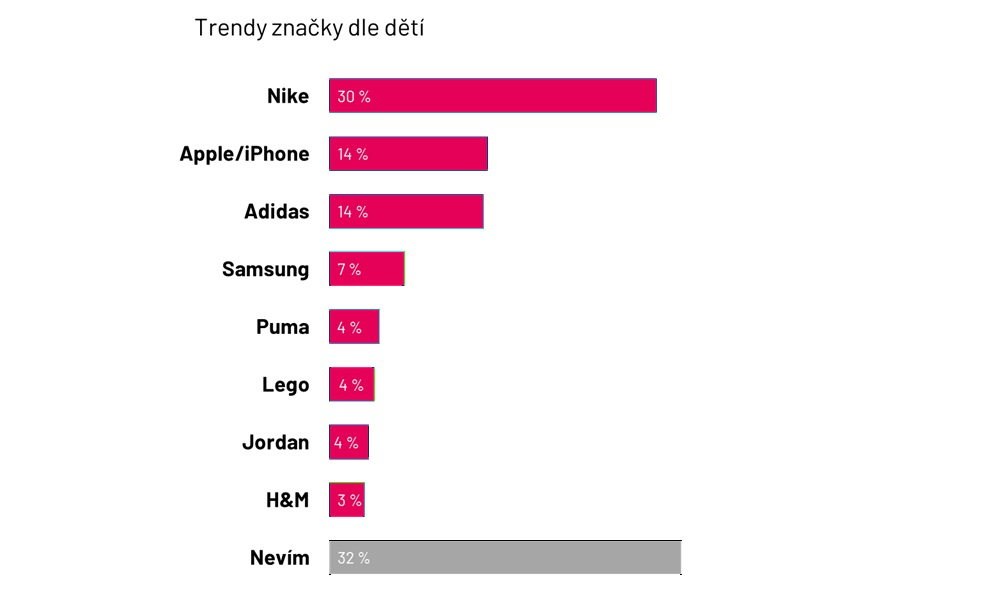 Trendy brands spontaneously named by Generation Alpha. Question: D1. Which brands do you think are trendy? Which ones do you like and consider to be the best? D2. And which brands do you think are out of fashion and would make you feel embarrassed? Sample: Children N=223, source: Ipsos
The importance of brands in children’s perceptions grows with age. It is essential for children that brands are visible on social media and among their peers (such as Nike, Netflix, Adidas), that they are useful and functional in terms of value for money and their contribution to values such as health or the environment (e.g. Duolingo, ČT:D, Samsung), and that they offer freedom and entertainment (TikTok, Instagram, YouTube, Decathlon). Brands introduced into children’s lives by their parents also have an influence, and are consequently perceived as safe (dm, Pepco, Decathlon).
Parents make the decisions in banking
Whilst children have a say in everyday shopping, when it comes to finances, the main decision-making remains with parents. They prioritise safety and financial education above all else.
However, the oldest members of Generation Alpha are already beginning to gain their own financial experience. Up to 90% of children aged 12–14 have their own money, and most of them also have a children’s bank account. Children most often associate banks with money, payment cards or cash machines. Cash still dominates the payments sector, but cashless payments via mobile phones or smart devices are gradually emerging.
More than half of children already use AI, with YouTube leading the way
Generation Alpha is growing up in a digital environment. They most frequently use smartphones, tablets, smartwatches or games consoles, and their favourite apps include YouTube, TikTok, WhatsApp and Instagram.
The research also highlights a difference in perceptions of online safety. Whilst 90% of children feel safe online, parents are more pessimistic, with 59% of them believing that children are safe online.
The rise of artificial intelligence is another technological phenomenon. AI is used by 56% of children aged 8–14, most commonly for schoolwork, searching for information or finding explanations for topics they do not understand.
The research also shows that children of the Alpha generation come into contact with digital technologies very early on. Their first personal device is most often a tablet, which children start using on average at the age of 3.9 years. They initially borrow a mobile phone from their parents and receive their own smartphone at around the age of 7. According to the authors of the research, however, the actual first contact with a smartphone often occurs even earlier than at the age of seven, namely at around the age of 4. According to the researchers, parents tend to underestimate the actual age of their child when they first use a smartphone.
The dominant digital platform among children is YouTube, which is used by 86% of children who use social media. Other social media platforms follow at a distance: Instagram (55%), TikTok (37%), Facebook (31%), Snapchat (24%), Pinterest (19%) and Twitch (5%). Girls generally use social media more frequently than boys, who in turn spend more time playing games.
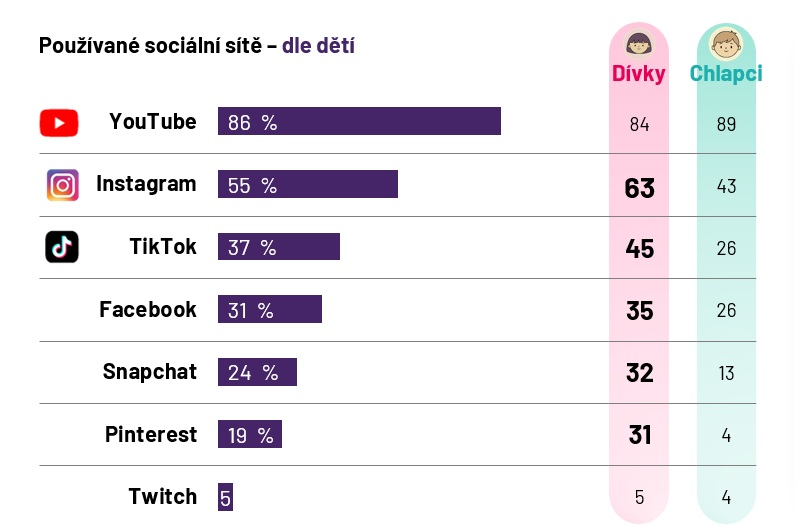 Social media platforms used by children. Question: Which social media platforms do you use? Children aged 8–14 who are on social media (in D4 – enjoy using them) (N=108); Source: Ipsos
Children use digital devices primarily for entertainment. Parents’ perceptions of what their children watch online also differ from reality. According to parents, the most common activity is playing online games, but in reality, children spend even more time online watching influencers (streamers and celebrities). According to the children themselves, this is their most frequent online activity. Gaming and e-sports are the second most common activity, followed by comedy videos and dance videos.
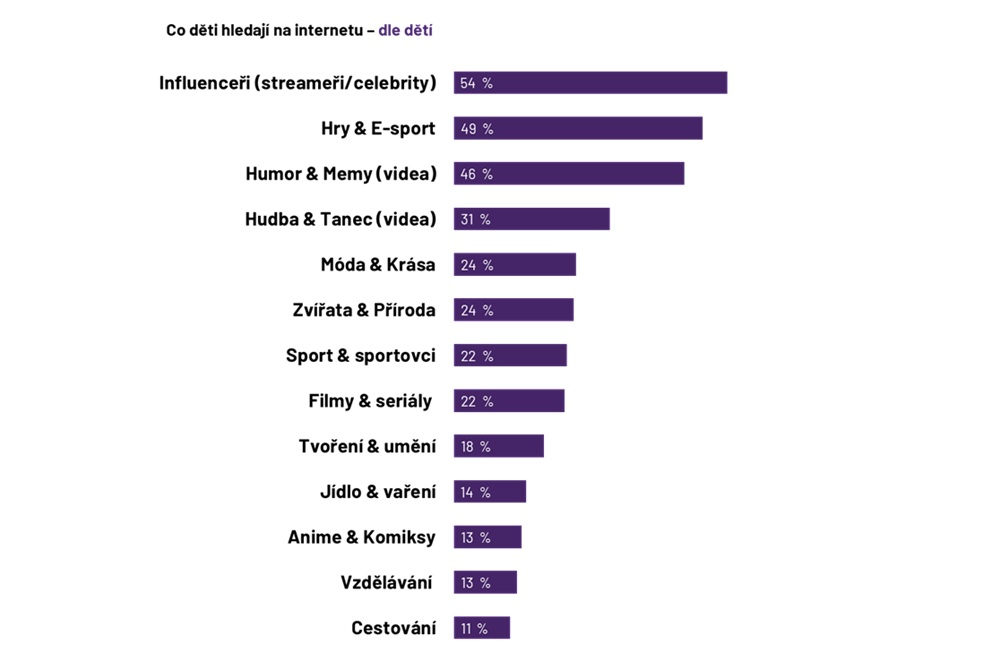 What children look for online – according to the children. Question: What do you like to do on digital devices (mobile, tablet, computer, TV, games console)? Children aged 8–14, N=223 D5. What topics do you follow or search for online? Source: Ipsos
The influence of Asian pop culture
Qualitative interviews with children revealed that they have a strong affinity for contemporary Asian pop culture. According to the study, this is more pronounced among Generation Alpha than in previous generations. It manifests itself in an interest in Korean cosmetics, accessories or streetwear inspired by K-pop. Asian TV series and music (BTS, Blackpink, Stray Kids, Squid Game) are also gaining popularity. Asian elements are also appearing in the gaming world, for example on the Roblox platform or in the game Fortnite, which collaborates with projects inspired by K-pop aesthetics.
Generation Alpha 2025 Research
The Ipsos survey focused on children aged 3 to 14 (pre-schoolers and primary school pupils) and their parents. Data collection was carried out by the Ipsos research agency in October and November 2025. The study combined qualitative and quantitative approaches. The qualitative part consisted of an in-depth analysis based on 14 in-depth interviews with children or siblings aged 3–14 and their parents. The research was also supplemented by an ethnographic analysis: a three-day digital ethnography on the WhatsApp platform, in which children aged 10–14 took part. The quantitative part was carried out in the form of a questionnaire survey. This involved 333 parents and 333 children divided into three age groups: 4–7 years (N=110), 8–11 years (N=112) and 12–14 years (N=111).)
Source: mediaguru.cz