

What you will find in the article:
- Artificial intelligence speeds up and streamlines marketing processes.
- AI does not replace experts, but expands their capabilities.
- New tools enable the effective use of existing data.
- Data quality and human judgement remain key.
- AI helps in the creation of creative concepts and campaigns.
Artificial intelligence in marketing is moving from experimentation towards practical application. Presentations on the first day of this year’s Brand Management conference organised by Blue Events, which took place in Prague this week, revealed that AI is now making inroads into data processing, analytics, and the creation of campaigns and creative content. Although individual approaches vary, the speakers agreed on one point. AI alone does not replace marketers, researchers or creatives, but it expands their capabilities and speeds up work that previously took days or weeks.
AI as a bridge between questions and data
Jiří Udatný from Seznam presented a new tool from the Czech internet leader, Datakompas, which links what people state in surveys (specifically the NADA survey) with how they actually behave (based on the real-world behaviour of millions of Seznam users). AI then acts as an intermediary between a marketing question and extensive data sources. It breaks down the query, searches for relevant information, carries out an analysis and offers recommendations. This makes it possible to uncover business opportunities and challenge stereotypical notions about purchasing habits and the behaviour of different customer groups. Work that took days or even weeks just half a year ago can now be handled by the tool in a matter of minutes, without the user even needing to know how to use statistical software.
Looking ahead, Seznam aims to evolve Datakompas from simply answering the question “who is my customer?” into a comprehensive platform for strategic marketing decisions. It aims to supplement real sales data from around ten thousand online shops with advertising monitoring data and trend tracking linked to media investments.
However, Jiří Udatný warned that it is not enough simply to apply a language model to any data. High-quality data and the right methodology are essential, and the agent must be trained so that it does not make things up and is able to handle, for example, weights or missing values. In his view, the greatest benefit of AI is not text generation, but the fact that, in an increasingly complex data landscape, it enables us to ask ever simpler questions.
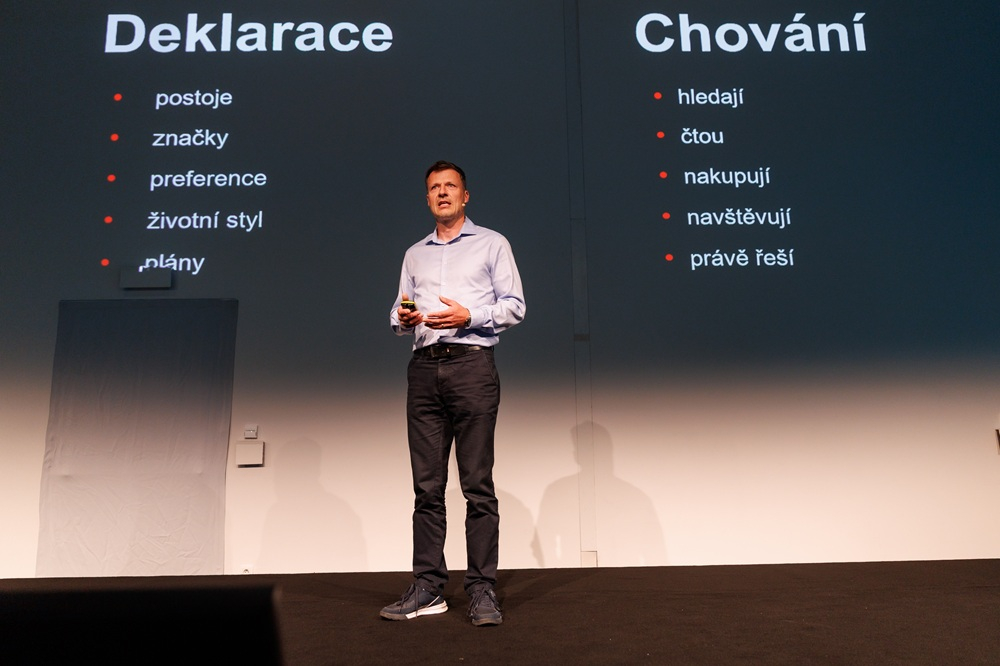 Jiří Udatný at the Brand Management 2026 conference; Source: Blue Events, photo: Jiří Šeda
Hana Kloučková from the research agency Confess Research also described a similar approach. According to her, companies today do not suffer from a lack of data, but from an inability to use it effectively. Only about a tenth of research findings make it into the final presentations from research agencies; most of the data therefore remains in spreadsheets, interview transcripts or internal files. Companies then often commission new research, even though they already have the answers to their questions.
The agency’s tool, called Brain, addresses precisely this problem by enabling users to search research databases using natural language. Users can ask questions about older research, and the system will find the answer as well as the source data on which it is based. According to Hana Kloučková, this transforms a research report from a static document into a living knowledge base that can be reused repeatedly for decision-making, innovation or marketing planning.
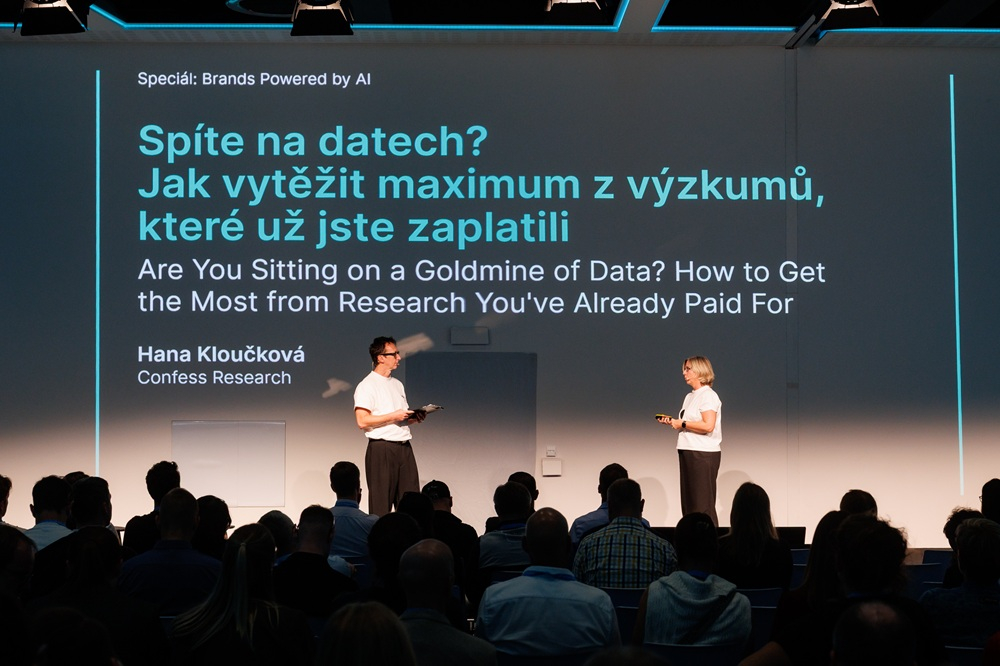 Hana Kloučková (right) with Jan Sud (McCann Prague), who moderated the conference on the first day; Source: Blue Events, photo: Jiří Šeda
Hana Kloučková (right) with Jan Sudou (McCann Prague), who moderated the conference on the first day. Source: Blue Events, photo: Jiří Šeda
AI speeds up campaign development
Tomáš Pavlíček from Alma Career described his experience with a campaign for the Jobs.cz job portal, which celebrated its 30th anniversary this year. The campaign was developed under time and budget constraints, and AI became an integral part of the production process. The result was a hybrid model in which the traditional roles of direction, production and post-production were retained, whilst the visual elements were created using AI tools.
Thanks to the use of AI, it was possible to reduce both costs and the time required by approximately half. Furthermore, AI enabled rapid testing of creative variations and real-time adjustments to visuals. Pavlíček nevertheless pointed out that AI is not a universal substitute for traditional production. Every project requires a different approach, and technology is evolving so rapidly that tools used just a few months ago may no longer be the first choice today.
Creativity yes, but not without human oversight
Slovak marketer Peter Šebo also highlighted the need for human oversight. In his presentation, he showcased several campaigns in which AI had assisted with the creation of visuals and creative concepts.
Using the example of a campaign for Lira chocolate, he demonstrated that AI can generate designs in a matter of seconds, the production of which would have entailed significantly higher costs and greater production complexity in a traditional studio. The resulting creative work also proved to be commercially successful. According to Šebo, however, there must never be a situation where AI-generated content leaves the company without human oversight. In his view, responsibility for the output remains with humans. AI expands the possibilities for creation and experimentation, but it does not replace judgement or decision-making.
AI thus proves to be, above all, a tool for dealing with complexity. It enables faster data processing, more efficient use of research, the creation of creative concepts and the testing of new ideas. At the same time, however, warnings were voiced against the notion that technology alone will solve marketing problems. The quality of the input data, methodology, customer knowledge, creative judgement and ultimate responsibility remain with people. The greatest benefit of artificial intelligence does not lie in replacing experts, but in enabling good marketers, researchers and creatives to work faster, more efficiently and with more information than ever before.
Source: mediaguru.cz