

Pay-TV will remain a significant part of the European television market in the coming years. According to the latest analysis by Dataxis, nearly 55 per cent of European households will have a direct subscription to a pay-TV service by the end of this year. Compared with 2021, this represents an increase of 1.6 percentage points.
By 2031, the proportion of households with pay-TV is expected to return to roughly the same level as in 2021. At a pan-European level, the market is therefore showing relative stability, although the situation varies significantly from country to country. A more pronounced decline in subscriber numbers is being recorded particularly in the UK, the Benelux countries and the Nordic markets. Conversely , France, Italy and Spain are showing growth and are expected to remain the market’s driving forces in the coming years. Analysts also anticipate dynamic growth in Portugal, Greece and Poland.
The way in which pay-TV is distributed is undergoing a fundamental transformation. According to the report, over-the-top (OTT) television services have evolved from a niche alternative into a fully-fledged competitor to cable, satellite and IPTV platforms. Many operators are therefore shifting their core television services to a streaming environment.
Examples include the Czech platform Oneplay, owned by TV Nova and O2, which was created by merging television and streaming services. In Norway, the operator Telenor is switching to streaming, whilst in Germany, Deutsche Telekom is also supporting internet distribution. In France, the growth of OTT is being driven by the expansion of standalone broadband packages without a TV set-top box.
The transition to internet distribution is also taking place among premium TV providers. Operators Canal and Sky are gradually migrating customers from satellite reception to OTT services. Alongside them, standalone streaming platforms are also gaining ground, including, for example, Polsat Box Goin Poland, Kyivstar TV in Ukraine, TimVision in Italy and Waipu.tv in Germany.
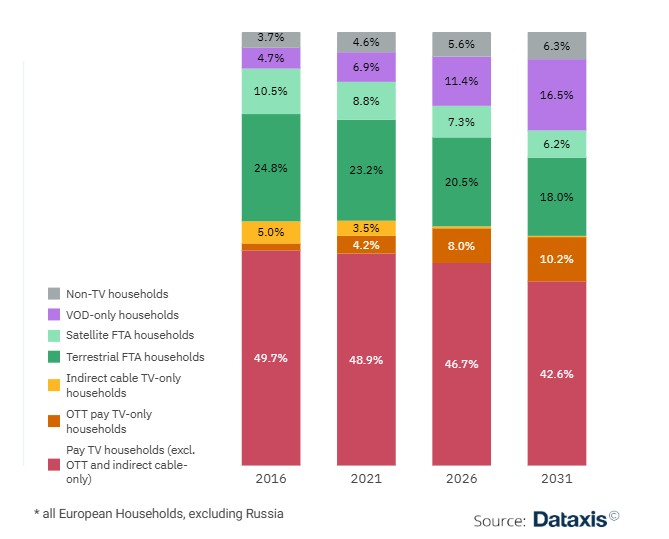 Proportion of European households with pay-TV by 2031; Source: Dataxis
The proportion of households without access to linear television in Europe continues to rise and, according to the analysis, is set to exceed 20 per cent over the next five years. The majority of this group consists of households that use neither free-to-air terrestrial reception nor pay-TV services. The shift away from traditional distribution channels is driven primarily by the rapid proliferation of smart TVs and on-demand content apps, which allow users to access programmes via SVOD and AVOD platforms.
This trend is having the greatest impact on traditional free-to-air television. The proportion of European households relying exclusively on satellite or terrestrial reception has fallen from more than a third in 2016 to the current 28 per cent. It is estimated that over the next five years, a further eight million households will switch away from this method of reception. This trend does not take into account the potential impact of future debates on the switch-off of digital terrestrial television (DTT) and satellite services, which are only just beginning to be rolled out in a number of European countries.
Source: mediaguru.cz