

The SXSW conference has always been a reliable “seismograph” for the themes shaping marketing, the entertainment industry and business as a whole. For a long time, its heart was the Austin Convention Centre with its distinctive 1990s charm. This year, however, it disappeared – it was demolished. SXSW 2026 thus took place without its centre, scattered across hotel ballrooms in the city centre. Finding one’s way around the conference suddenly required a different approach, notes Alex Turtschan from the media agency Mediaplus in his review.
It was precisely this feeling that proved symbolic. Journalist and bestselling author Jennifer B. Wallace opened the conference not with a technological prediction, but with a question about human behaviour. We find ourselves in the midst of one of the greatest waves of innovation in history, and yet as a society we are turning to the past. Vinyl sales are rising, people are travelling for hours to restaurants styled precisely in the 90s. According to Wallace, however, this is not nostalgia for things, but for feelings – for a sense of belonging that used to be a natural part of everyday life.
This theme ran through the first three days of SXSW 2026. Many talks from various perspectives reached the same conclusion: whilst the impact of AI on business attracts maximum attention, its influence on the lives of people and consumers remains almost overlooked.
The end of trend reports
On Saturday morning, futurist Amy Webb took to the stage with her traditional report on emerging technology trends, which she has been presenting at SXSW for the past 15 years. This year, however, she began with an unexpected statement – trend reports, she argued, are dead, because isolated trends can no longer explain a world where everything happens simultaneously and intertwines.
Instead, she introduced the concept of convergences – systemic changes arising from the interaction of multiple trends, such as the augmentation of human capabilities, the unlimited workforce, or the outsourcing of emotions.
The first two describe structural changes: both economies and labour systems were built on the assumption that productivity is generated by people. AI and robotics are undermining this foundation. However, whilst most debates focus on the economy, the third convergence points elsewhere – towards the impacts on people’s emotional and social lives.
Outsourcing of emotions
Webb defines this concept as the shift of the need for comfort, recognition and closeness towards machines. It is a gradual process: substitution turns into dependence, and that into infrastructure. The emotional burden is shifting from people to systems. Emotional AI is becoming invisible, taken for granted and indispensable.
Whoever controls this infrastructure indirectly controls how people feel – even before they start thinking, voting, shopping or trusting.
According to Webb, the business logic is simple: first isolate people, then sell them connection. First automate their work, then sell them meaning.
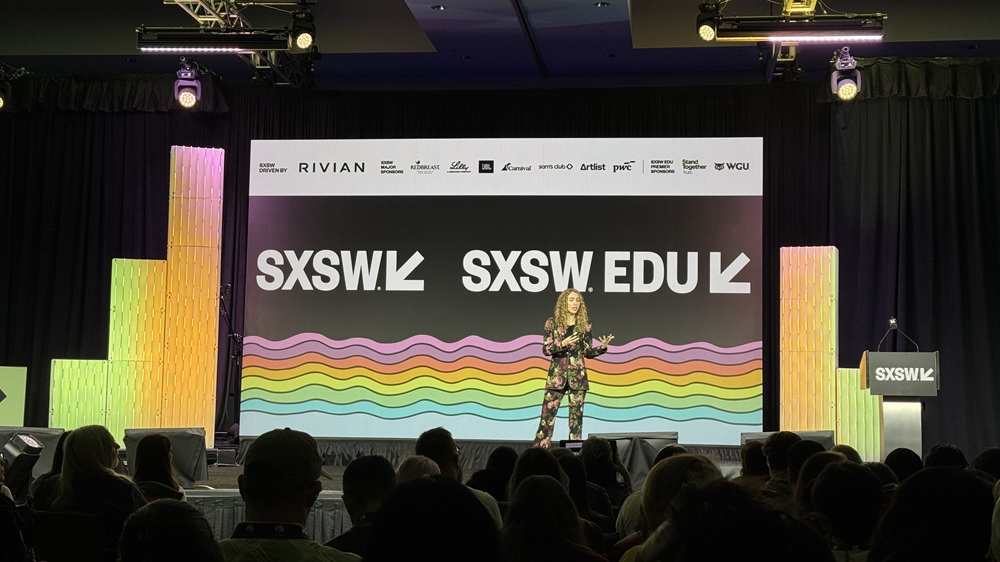 Kasley Killam at the SXSW 2026 conference; Source: Mediaplus
The transformation of the consumer
Whilst Webb described the system, other speakers added perspectives on specific individuals. Social scientist Kasley Killam, who defined social health as the third pillar alongside physical and mental health, presented alarming data. Family dinners have fallen from 84% among older generations to 38% among Generation Z. The query “how to make friends” is currently the top search globally.
According to Killam, 49% of Generation Z already have a meaningful relationship with AI, and 37% can imagine falling in love with an AI partner.
People are thus outsourcing their emotional needs to machines at precisely the moment when their real-life social bonds are weakening. According to Killam, social health is mirroring the trajectory of mental health a decade ago – only much faster, because technology is actively reshaping the conditions.
Linguist and creator Adam Aleksic highlighted another layer: language. AI models, trained primarily on formal texts, favour a certain type of vocabulary. People unconsciously adopt these linguistic patterns – and since 2023, their use has demonstrably been on the rise. In other words: people’s language is changing under the influence of tools they regard merely as aids.
Aleksic goes even further: social media algorithms not only spread culture, but also create it. For example, Spotify named the genre ‘hyperpop’ based on listener data, thereby effectively creating it. Other trends emerge in a similar way, appearing organic but resulting from algorithmic selection.
Rohit Bhargava followed on from this, presenting his forthcoming book Future Words – a collection of new terms for contemporary phenomena. In the context of algorithmically generated language, this represents an effort to consciously name a reality that would otherwise remain unnamed.
The other side of data
Whilst Webb, Killam and Aleksic described systemic changes, other speakers brought a less measurable but important dimension to the discussion. Natalia Davila from the Gut agency pointed out that love – in its irrational and unruly form – still influences consumer decisions more than any customer map.
The conference thus painted a clear picture:
- More and more people are forming their closest relationships with machines; their language is subtly changing; and the culture they consider spontaneous may in fact be the product of algorithms.
- This does not mean that traditional marketing is ceasing to work. However, it raises the question of whether brands are still targeting the same consumer – or someone who has, in the meantime, undergone a fundamental transformation.
The closing note was provided by actress Jamie Lee Curtis, who – consciously or not – paraphrased Maya Angelou: when a person dies, no one remembers how much money they had or how successful their business was. People remember what they were like, how they treated others, and how they made them feel.
Perhaps that isn’t the worst takeaway from this year’s SXSW.
Source: mediaguru.cz