

A new peer-reviewed study by Juniper Research highlights the systemic problem of fraudulent advertising on social networks and the economic incentives that support its long-term prevalence. The white paper, entitled Protecting Users from Scam Ads: A Call for Social Media Platform Accountability, quantifies for the first time the financial benefits that platforms derive from scam ads and concludes that advertising revenues often exceed the costs of combating them effectively.
These are deceptive digital advertising messages designed to entice users to engage in fake offers, services or investments. They often use misleading promises, false recommendations or impersonate well-known brands, companies or retailers. The goal is to lure users into paying for non-existent products or to get them to invest in fraudulent schemes.
According to estimates by Juniper Research, social platforms in Europe generated approximately €4.44 billion, or roughly £4.4 billion, from fraudulent advertising in 2025. Fraudulent formats accounted for approximately ten per cent of all social media advertising revenue. The study also shows that European users were exposed to approximately one trillion fraudulent advertisements in 2025, which corresponds to an average of approximately 190 impressions per user per month. If the current trend continues, this number is expected to rise to 250 by 2030.
According to the study, Czechia is significantly above the European average. Fraudulent advertisements targeting Czech users in 2025 are estimated to have generated approximately €139 million, or roughly CZK 3.4 billion, for platforms. The share of revenue from these ads reached 14.5 per cent in Czechia, which means that approximately one in seven ads displayed was fraudulent.
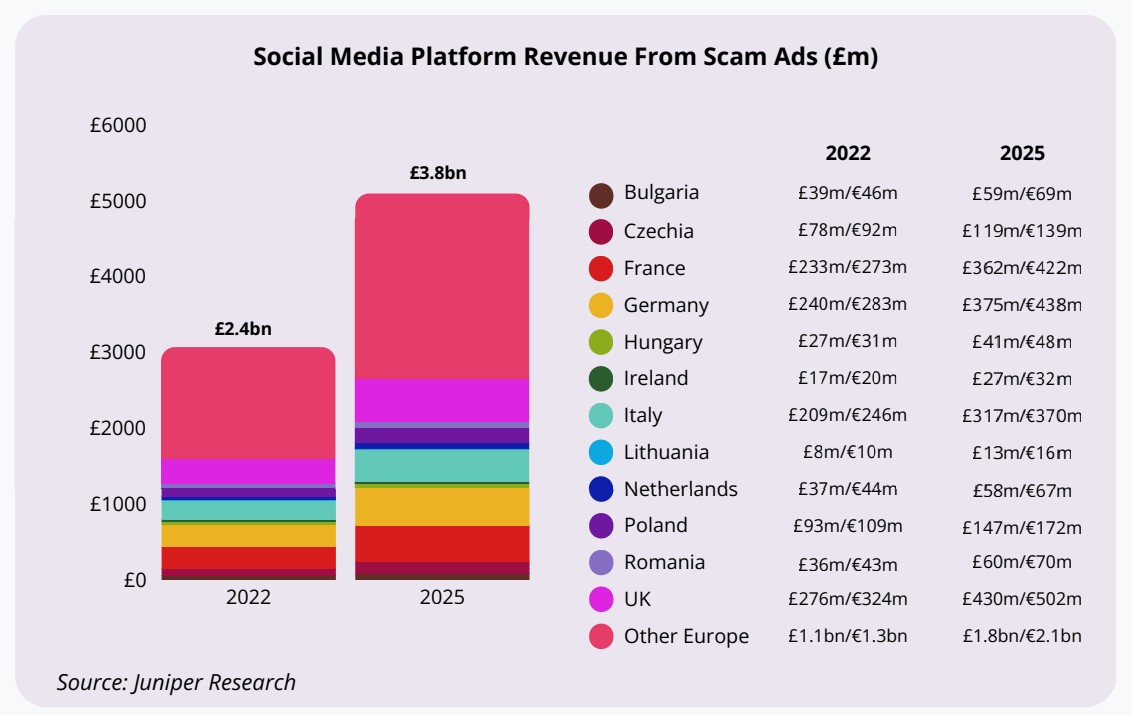 Volume of fraudulent ads on social networks in European countries; Source: Juniper Research
The authors of the study point out that quantifying these revenues helps explain why platforms often take a reactive rather than a systematic approach to solving the problem. Without a shift towards proactive verification of advertisers and advertising content, Juniper Research believes that the volume of fraudulent advertising could continue to grow. By 2030, social platforms in Europe could generate more than €10.3 billion from scam ads, with the number of impressions exceeding 1.4 trillion and the average user encountering fraudulent advertising about a third more often than today.
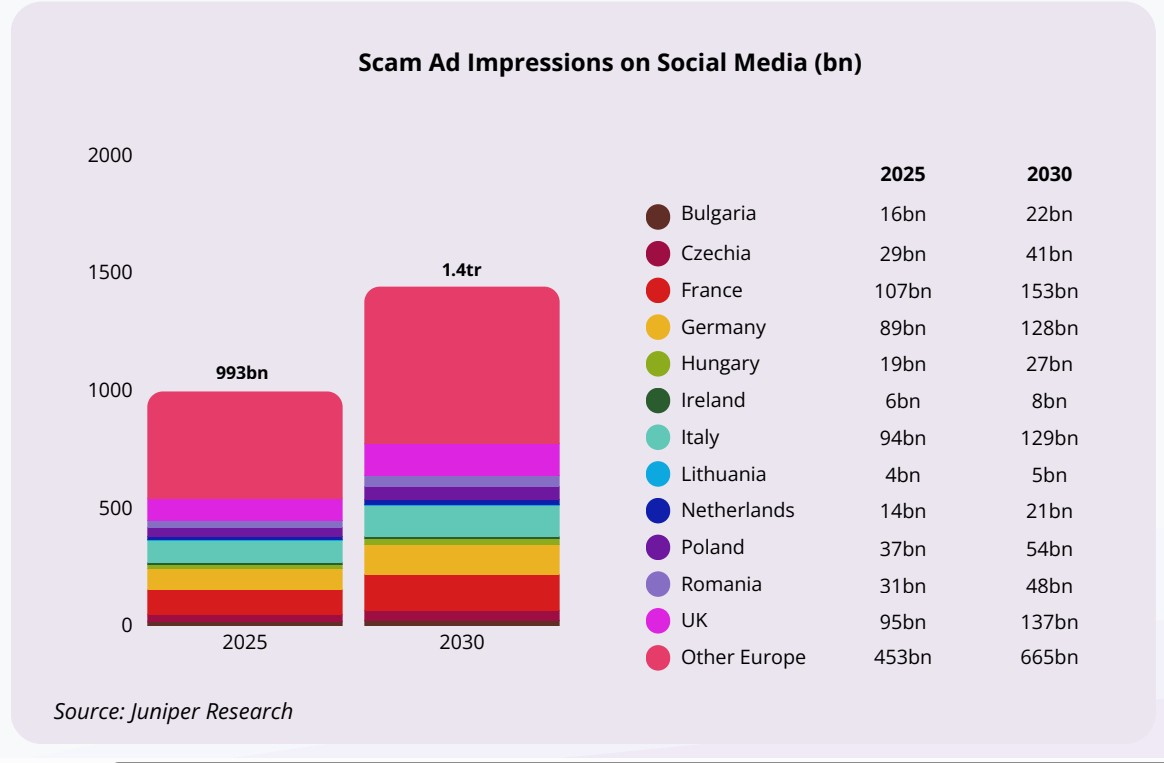 Predicted revenue from fraudulent ads in individual European countries in 2025 and 2030; Source: Juniper Research
The study also warns that although short-term advertising revenues may grow, the long-term consequence will be an erosion of user trust, which could negatively affect the value of the platforms themselves.
According to the authors, the dataset, analytical framework and conclusions were compiled independently by Juniper Research on behalf of the financial technology company Revolut, with the methodology and results undergoing internal expert review. Revolut did not participate in the creation of the data or conclusions.
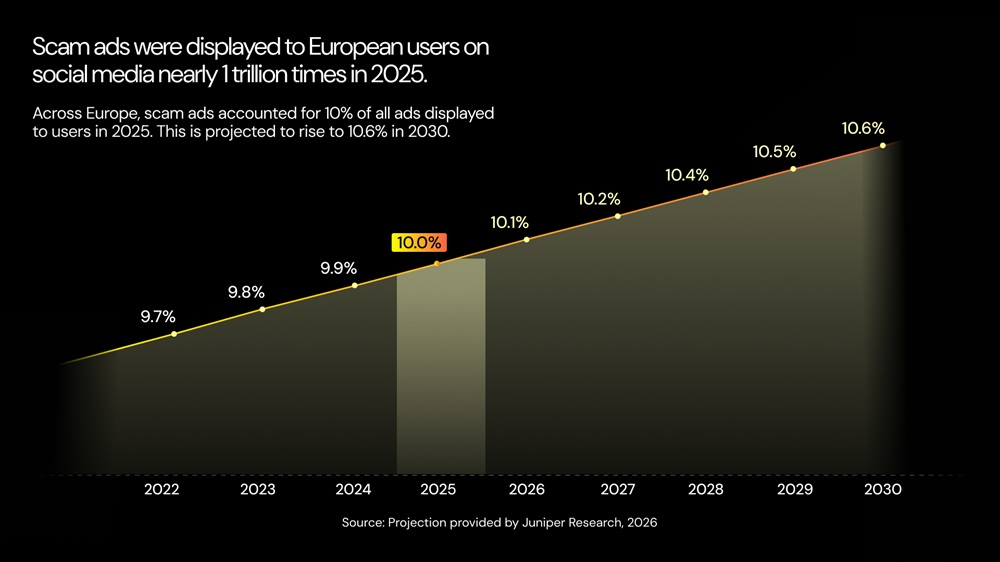 Percentage of defective advertisements in the total number of advertisements displayed on social networks in Europe; Source: Juniper Research
About the study
Methodology
Juniper Research based its study on publicly available data from the largest social platforms in Europe and its own analytical databases on population, number of adult users and social media usage. The analysis focuses exclusively on platforms whose main function is social interaction, content discovery and algorithmically controlled display of posts – specifically Facebook, Instagram, TikTok, Snapchat, X (formerly Twitter) and LinkedIn. Conversely, it does not include video streaming services or communication applications.
The volume of ads displayed was estimated based on verified data on ad impressions and publicly available price indicators (CPM), which were incorporated into predictive models. The incidence of fraudulent ads and related losses were assessed using open data sources and historical data, with the authors noting that the actual extent may be higher due to the fact that not all cases were recorded.
Source: mediaguru.cz