

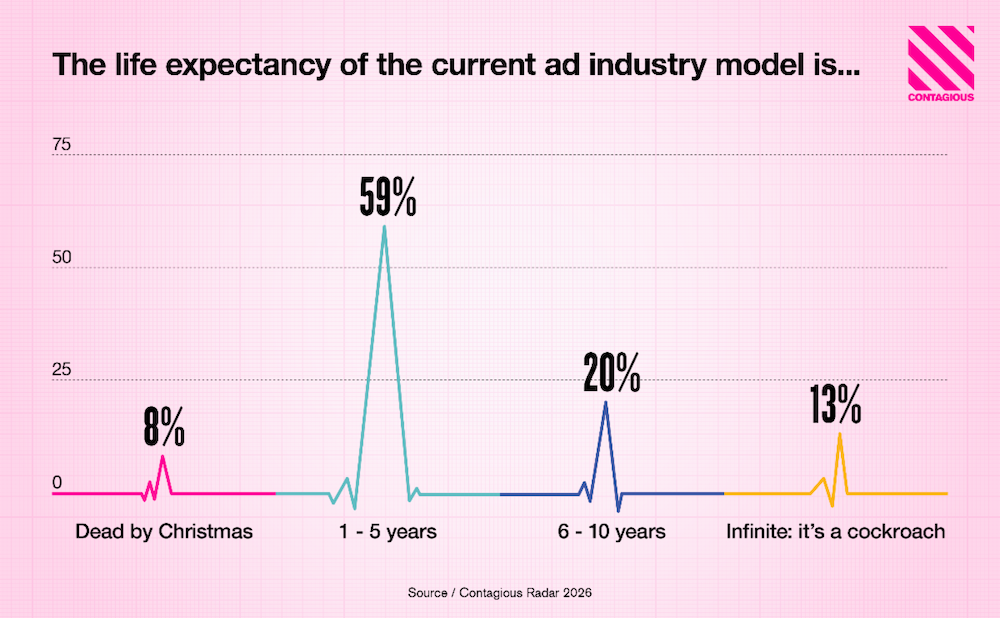
Two-thirds of marketers and creatives believe that the current model of the advertising industry has a maximum lifespan of just five years. More than a quarter of advertisers believe that artificial intelligence is rendering agencies obsolete. This is according to the Contagious Radar 2026 report, which identified six key trends shaping marketing and advertising.
According to the majority of respondents, the current structure of the advertising industry cannot survive for more than five years. According to almost a tenth (8%) of respondents, the current model will not even last until Christmas; conversely, 13% of respondents believe it will never change.
 In the era of artificial intelligence, which can write copy, create key visuals and devise strategies, the value of advertising agencies is beginning to be called into question. Whilst last year only 15% of agencies and 11% of clients believed that agencies were losing value in the age of AI, this year the figures have risen to 22% of agencies and 28% of clients.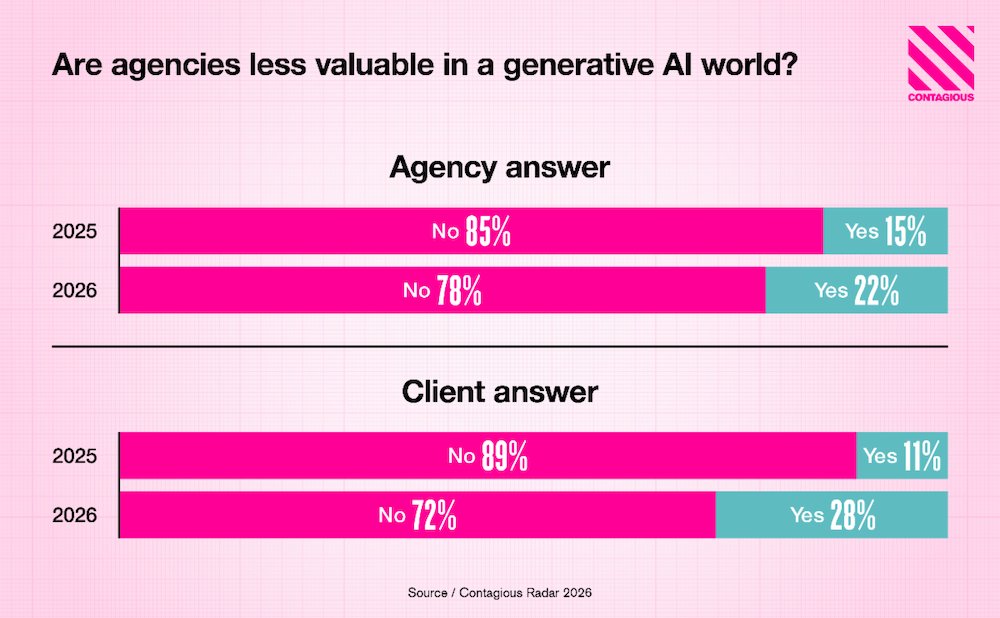
“Welcome to the Cold War of artificial intelligence. The year 2026 represents a delicate balance of automation – a race driven by efficiency, overshadowed by existential unease. This unease permeates the six trends we explored in this year’s Radar, and encapsulates our unceasing desire for meaning, comfort, connection and protection. A clear human thread runs through all the trends: the desire for a little more control, a little more autonomy in the face of relentless uncertainty,” comments Katrina Stirton Dodd, editor at Contagious.
The six identified trends include:
(1) People’s attention spans are shrinking
In a world of endless content possibilities, attention spans are shrinking, memory is deteriorating and meaning is fading away. Platforms such as Netflix, YouTube and TikTok overwhelm users with a never-ending selection, and artificial intelligence only amplifies this deluge. People are cognitively overloaded, so it is no surprise that short-form content takes precedence, offering effective entertainment that remains superficial. Brands face the challenge of how to engage tired and overwhelmed consumers. The solution is to produce less content and focus on quality.
(2) Playing the nostalgia card
Nostalgia today is not a fleeting pleasure, but a state of mind. It represents a strong emotional anchor in a chaotic world. People are buying vinyl records, Generation Z admires the 90s, and some brands are returning to the year 2000 in their campaigns, trying to tap into the emotions of that ‘rosy’ past. Even so, one must be careful, because history is not a creative idea.
(3) Disconnected by loneliness
Although social media was originally created with the aim of fostering greater human connection, today it often goes in the opposite direction. People oftendevote themselvesto virtual online contacts rather than personal relationships. In the US, 28% of adults report having had at least one intimate or romantic relationship with artificial intelligence. Brands have an opportunity to counter this trend and promote a sense of belonging and face-to-face encounters in the real world.
(4) Social media as a vice
The debate surrounding social media has shifted from the potential for connecting with others to the protection of users. There is strong public support for banning social media for those under 16, particularly due to its negative impact on mental health and its addictive nature. Brands should navigate this landscape, prioritise an ethical stance and explore safer online environments, such as podcasts.
(5) Self-improvement is a must
Contemporary culture places an emphasis on perfect appearance, a trend fuelled by phenomena such as #glowup on TikTok, the first cosmetic ranges for children offered by brands such as Rini, and, last but not least, the ideal of beauty promoted by artificial intelligence. In this world, self-improvement is becoming an obligation. Rather than adding to the pressure, however, brands should encourage authenticity and a positive self-image among consumers.
(6) The death of ambition
Traditional goals, such as buying a home or getting a promotion at work, are becoming increasingly unattainable, particularly for the younger generation. Instead, consumers are focusing on the present, small pleasures and professional minimalism. According to Ipsos, two-thirds of people agree that they live for the here and now because the future is uncertain. Brands such as Ikea and Asics therefore strive to present the present as meaningful in their communications – after all, if you cannot rely on the future, it is wise to invest in today.
Source: mediaguru.cz