

What you will find in the article
- Czechs are looking for a meaningful life, good health and quality relationships
- Generation Alpha is influencing household spending and spending time online
- Viewing figures for television outside the home are being driven mainly by sports broadcasts
- A successful campaign can work even without TV adverts
Czechs are increasingly striving to live in a way that makes sense to them. As many as 71 per cent of them consider the meaningfulness of the activities they spend their time on. Brands should therefore help people to live better lives, rather than simply owning more, according to the new Lifestyle 2026 study, which was presented by Petra Průšová from the Kantar agency on the Data & Insight Stage of the SIMAR association at this year’s Forum Media conference.
According to the 15th edition of the study, Czechs currently feel very content – in fact, they are the most content in the Central European region – and most people view their lives in a relatively positive light. Nevertheless, they still harbour significant concerns about the future – fewer and fewer people believe that the world around them will remain as stable and predictable as before. As many as 84 per cent feel that the world around us is becoming less safe, 77 per cent express concerns about future developments, and 58 per cent consider it likely that a large-scale armed conflict will occur in Europe in the near future. People are also afraid of old age and their preparedness for retirement – two-thirds of Czechs already know that they will not be able to live on their pension alone.
For 59 per cent of Czechs, good health is a more significant indicator of a successful life than professional or material achievements. As many as 68 per cent prioritise quality of life over its maximum duration, and for 54 per cent, meaningful interpersonal relationships are an important part of health and overall well-being.
Brands should therefore focus less on selling products and more on helping people lead better, healthier and more meaningful lives. They should support people’s everyday wellbeing, offering growth and self-development to some, and mental wellbeing and comfort to others. At the same time, they should respond to the growing importance of shared activities, clubs and community experiences, as well as to the increasing fatigue caused by constant online availability. As AI becomes part of Czechs’ lives, they increasingly value authenticity, human relationships, real-life experiences and creativity.
Up to 73 per cent of children influence household purchasing decisions
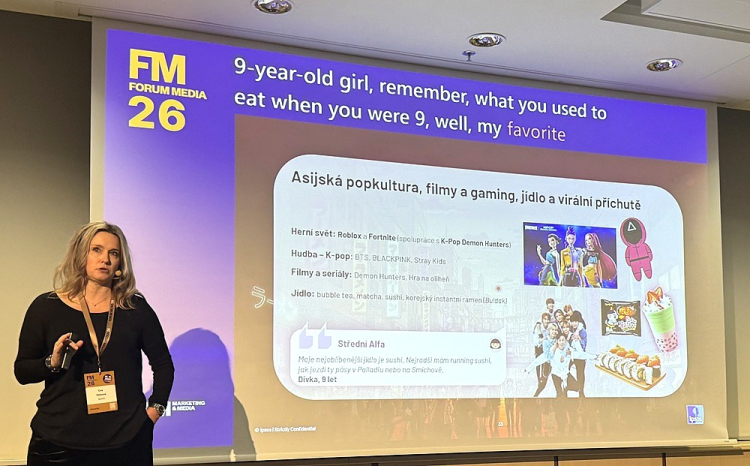
Eva Veisová from Ipsos discussed Generation Alpha, which is already having a significant influence on the purchasing behaviour of entire households, in her presentation. For today’s children, aged between 3 and 14, it is perfectly normal not to distinguish between the online and offline worlds and to combine digital entertainment with real-life experiences. Up to 73 per cent of them are involved in purchasing decisions – influencing both everyday choices (grocery shopping, cooking or choosing a restaurant) and more significant ones, such as holidays or choosing a new car.
In the eyes of Generation Alpha, the brands most spontaneously mentioned as trends include Nike, Apple and Adidas. “However, a third of Generation Alpha, aged between 8 and 14, do not even know or care which brands are trendy for them,” said Eva Veisová, adding that a brand is simply a label they see on social media and among influencers.
Technology plays a crucial role in the lives of Generation Alpha. They use smartphones the most; for the youngest children, it is smart TVs and tablets. If they already own a smartphone, they have dozens of apps on it, all perfectly organised. Most commonly, they use digital devices to play games (75 per cent), chat (56 per cent) and browse social media (48 per cent). Online, they most frequently search for influencers (54 per cent), games and e-sports (49 per cent), and humour and memes (46 per cent).
The most widely used social media platform is YouTube (86 per cent); girls also use other platforms, such as Instagram and TikTok, more than boys do. When creating their own content, girls are more likely to produce make-up, room tour and haul videos, whilst boys tend to produce gameplay, let’s play and review videos, or tech unboxing videos.
 Eva Veisová at the Forum Media conference; Source: SIMAR
Asian culture also has a significant influence on today’s children – not only do they buy Korean cosmetics, drink bubble tea or matcha, and enjoy sushi and instant ramen, but they also listen to K-pop and watch K-pop Demon Hunters
Sporting events are the most watched programmes outside the home
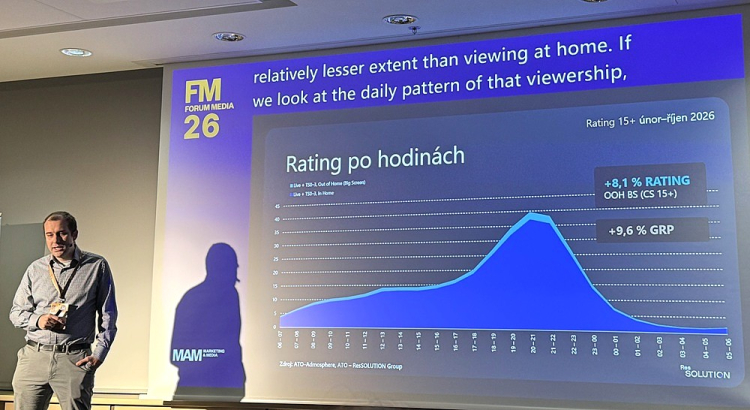
Jakub Fulín from the ResSolution agency presented the initial data on out-of-home TV viewing figures at the conference. The first nine months of measurement, which combines static people meters with mobile phone data, showed that out-of-home viewing behaves very similarly to viewing at home, albeit with minor differences. On average , thanks to out-of-home viewing measurements, total television viewing for the period in question increased by 8.1 per cent. The results show that people watch television outside the home mainly in the evenings, at weekends and during sporting events. For major ice hockey matches, this can amount to as many as 300,000 additional viewers.
The average time spent watching television at home is 3 hours, 12 minutes and 19 seconds per day; away from home, it is 15 minutes and 30 seconds. Both at home and away from home, the daily pattern of viewing is similar, peaking between 7 pm and 10 pm; however, the fluctuation is not as pronounced when watching away from home. Men watch more television away from home, with the highest viewing figures among the 15 to 24 age group. Among the most-watched programmes are ice hockey matches and biathlon. However, apart from sport, people also watch films, news, entertainment programmes and series whilst away from home.
 Jakub Fulín at the Forum Media conference; Source: SIMAR
A strong campaign can be built even without TV adverts
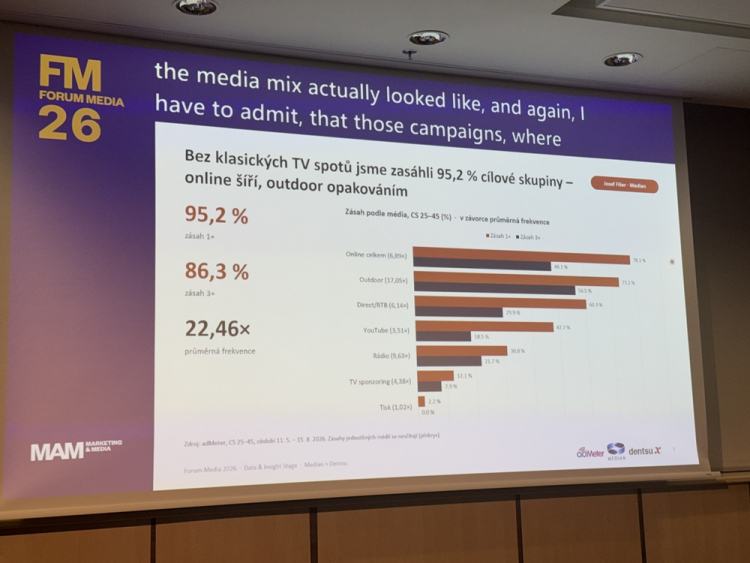
Milan Černík from Dentsu and Josef Fišer from Median presented a campaign that, instead of TV adverts, relied on a fragmented media mix comprising TV sponsorship, radio, outdoor advertising, YouTube, online video, banner formats and various purchasing models.
For an unnamed pharmacy chain, they devised the campaign‘I’ll sort everything for summer at the chemist’s’, which aimed to compete with established drugstores and link the product range to summer scenarios such as a trip to the seaside, going to a summer festival or camp. In addition to the aforementioned media mix, the campaign utilised activations in specific contexts, such as hypercubes at swimming pools, Tinder at festivals, billboards along cycle paths, and messages during the weather forecast on ČT 1 and TV Nova.
In total, the campaign delivered 43.984 million impressions and reached 95.2 per cent of the target audience. Following the campaign, people recalled the brand more frequently in connection with summer. However, it has not yet become the first choice for summer holiday purchases. According to Milan Černík, the reason for this is, on the one hand, that communication must be more long-term to achieve this goal, and, on the other hand, that the brand must be physically present in these situations.
 Presentation at the Forum Media conference; Source: SIMAR
People are more candid with an AI presenter
Petra Víšková from the Confess agency presented the potential of AI presenters in the research. She demonstrated how people will even tell Quinn, a moderator capable of working 24/7, things they wouldn’t even share with their closest friends – such as what they like to watch ‘in secret’ on television.
“An AI moderator can ask questions anytime and anywhere, never sleeps and offers respondents a safe environment – it doesn’t judge or evaluate,” explained Petra Víšková, adding that Quinn has also learnt projective techniques and can respond to emotions in the voice. It also proves its worth for hard-to-reach target groups – for example, in B2B – giving a voice to those who would otherwise remain silent, or enabling further probing even in quantitative research when dealing with open-ended questions.
However, after collecting a large number of interviews conducted by the AI moderator – for which a duration of 20 minutes has proven effective – it is essential to carry out a thorough analysis to extract insights from the data. According to Víšková, it is important not to rely solely on AI, but always to maintain human oversight and to combine its outputs with other methods.
AI must be used ethically in research
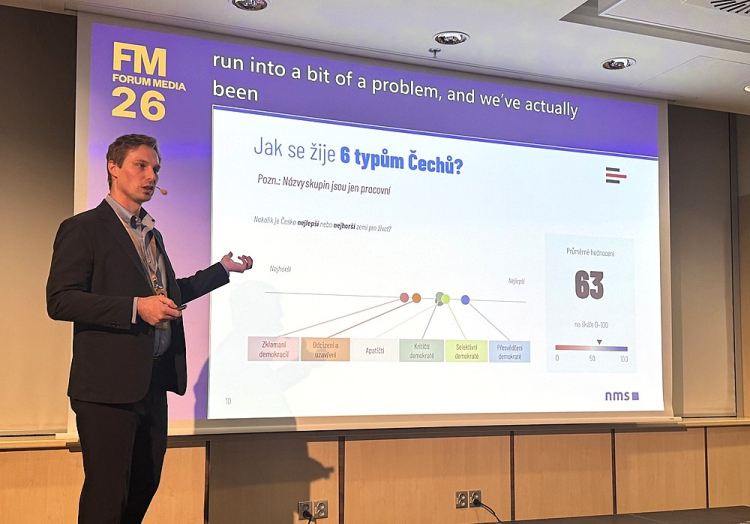
Jakub Bakule from NMS Market Research highlighted the ethical aspects of using AI in research in his presentation. His agency, in collaboration with Czech Radio, is preparing a survey that maps people’s attitudes towards democracy.
According to this, he distinguishes six groups of people:
- committed democrats (21 per cent), for whom democracy is a value and an everyday practice;
- selective democrats (15 per cent), who believe that democracy should not be for everyone;
- critical democrats (16 per cent), who are engaged sceptics; whilst they support democracy, they do so with reservations;
- those disillusioned with democracy (11 per cent), who do not believe that democracy works for people like themselves; their disillusionment with the functioning of the system has grown into a rejection of democracy as such;
- the alienated and closed-minded (18 per cent), who have virtually no interest in politics and hold no strong views on democracy; they are characterised by a rigid closed-mindedness and intolerance towards minorities;
- apathetic democrats (19 per cent), who do not question democracy or stand in the way of minorities, though not out of conviction, but rather because they are generally uninterested in politics and society as a whole.
 Jakub Bakule at the Forum Media conference; Source: SIMAR
In connection with this research, NMS is also developing a chatbot – a virtual persona – for which it is focusing in particular on credibility, the knowledge base, communication style, security and the boundaries it must not cross, so as not to undermine trust in the research.
Source: mediaguru.cz