

Lee Cronin’s The Mummy offers a new and significantly darker interpretation of the classic movie monster. Unlike the adventure-driven versions from the turn of the millennium, the filmmakers have returned to pure horror. The film was both directed and written by Irish filmmaker Lee Cronin, who first drew major attention with the successful horror film Evil Dead Rise. Two major figures of contemporary horror, James Wan and Jason Blum, were involved in the production of the new film through their companies Atomic Monster and Blumhouse Productions.
The new Mummy is conceived as a standalone film with no direct connection to earlier versions of the story, such as the classic 1999 horror film The Mummy or the action trilogy starring Brendan Fraser. Cronin offers a modern and considerably darker take on the familiar myth. The daughter of journalist Charlie, played by Jack Reynor, disappears during an expedition in the desert and is presumed dead by her family. Eight years later, however, she is found inside a sarcophagus and seemingly returns to life. It soon becomes clear, though, that her return marks the beginning of a supernatural catastrophe. Alongside Reynor, the film also stars Laia Costa, Natalie Grace, Verónica Falcón, and May Calamawy.
Cronin himself has said that one of his inspirations was the cult horror film Poltergeist, particularly its motif of a family confronting a supernatural threat within their own home. In an interview with the American online magazine IGN, he revealed that the film is based on the idea of deeply buried secrets and things we may not even know about. “The movie itself really is a mystery, and it’s a puzzle box, which was part of my draw towards it,” he said, adding: “I think for me what’s really interesting and exciting, certainly even from childhood and being drawn towards Egyptian lore and that entire world, is the secrets that exist and the hidden things.”
The horror and mystery of ancient Egypt fascinate the whole world
The director’s comments on his new film fit neatly into a broader cultural phenomenon: people’s long-standing fascination with dark themes, mystery, and horror. The combination of the unknown, danger, and ancient mysticism is one of the main reasons why this genre continues to attract audiences. According to psychologists, horror offers a safe way to experience fear or confront the darker sides of life — viewers can feel intense emotions without being genuinely threatened. That is why creators of advertising spots so often reach for elements of mystery, mild horror, or exotic mythology. And the motif of ancient Egypt is particularly attractive for this kind of storytelling. Egyptian symbolism — mummies, curses, sarcophagi, or secrets buried in the sand — naturally evokes a sense of ancient mystery and an unknown past.
The animated 1987 commercial for General Mills’ Fruity Yummy Mummy cereal, however, was not frightening at all:
Video: Fruity Yummy Mummy Commercial
Pillsbury, the American company famous for its croissants and rolls, also turned to the mummy motif, offering consumers a recipe for puff-pastry mummies. Essentially, these are sausages wrapped in strips of Pillsbury Crescent dough that resemble “embalming bandages.” Tempting enough to take a bite, wouldn’t you say?
Video: Crescent Mummy Dogs
LEGO and a Pharaoh’s adventure
In 2011, LEGO launched its adventure-themed building set series LEGO Pharaoh’s Quest, inspired by archaeological expeditions and Egyptian mythology. In doing so, it followed thematically in the footsteps of the earlier LEGO Adventurers series from the late 1990s, which also made use of desert expeditions, pyramids, and ancient curses. With Pharaoh’s Quest, LEGO developed the concept into a more modern form and built it around the popular iconography of ancient Egypt — pyramids, sarcophagi, mummies, hieroglyphs, and mysterious artefacts.
Video: LEGO® Pharaoh’s Quest – trailer
Samsung bet on the Sphinx and other remarkable structures
The renowned electronics manufacturer Samsung launched a campaign in Honduras in 2010 entitled “Statue of Liberty, Sphinx, Christ the Redeemer, Bee, Ants.” The print campaign, which included a mysterious sphinx, was created by the advertising agency Ogilvy.
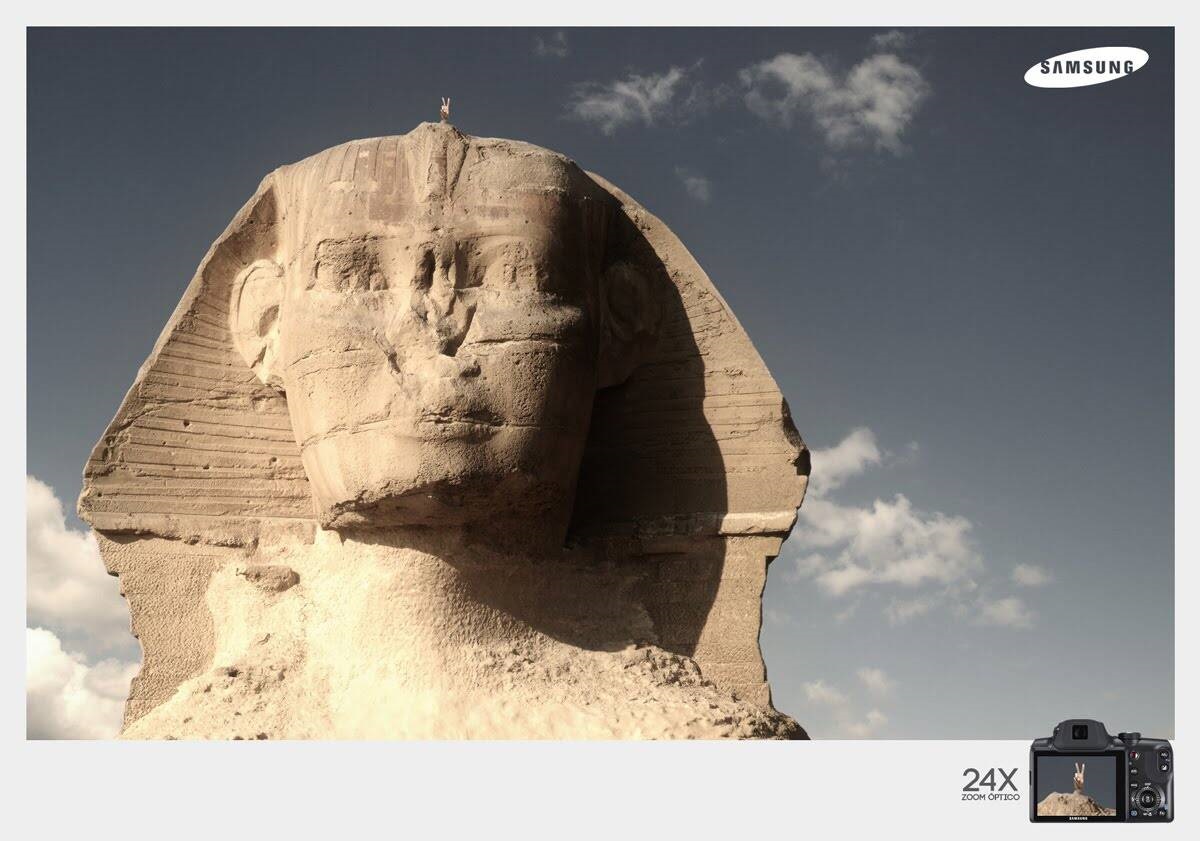 Credit: adsoftheworld.com
Amazon shows what life was like before Alexa
The commercial “Life Before Alexa – Egypt,” released by Amazon in 2020, is built on the contrast between complicated communication in ancient times and the simplicity of a voice assistant. In a scene set in ancient Egypt, priests are mummifying a body when they run out of bandages, so they write the shopping list by hand on a stone tablet. Life before the Alexa voice assistant simply was not easy — whereas with Alexa, it is essentially effortless.
Video: Amazon – Life Before Alexa – Egypt
Sony wraps the pyramids
Sony’s 2007 commercial for its Bravia televisions was filmed at the Egyptian pyramids. It shows thousands of spools of coloured thread cascading down the side of a pyramid. In reality, it was a combination of live-action footage and CGI. The television ad aimed to demonstrate the richness of the televisions’ colours.
Video: Sony Bravia – Pyramid
Burger King and the polite mummy
The fast-food chain made use of the mummy theme as part of its Monster Menu, which it regularly associates with the Halloween season. The commercial works with a simple comic contrast. Instead of the terrifying and dangerous creature usually seen in horror films, the mummy behaves in a surprisingly polite and civilised manner. As a result, the character comes across as more likeable than threatening, humorously subverting the viewer’s expectations in a charmingly funny way.
Video: BK – Monster Menu
A franchise with potential
The franchise consisting of the films The Mummy, The Mummy Returns, and The Mummy: Tomb of the Dragon Emperor was, at the turn of the millennium, a striking example of film marketing based on extensive franchise cooperation and brand licensing. Universal Pictures established partnerships with toy manufacturers, video game companies, themed attractions, and merchandising producers. A popular roller coaster called Revenge of the Mummy, inspired by the film world of mummies and ancient Egyptian curses, was created at Universal Studios parks. This type of synergistic marketing helped transform the film trilogy into a broader media brand that extended beyond the films themselves and utilised the iconography of ancient Egypt in a variety of products and entertainment formats.
The revival of well-known horror film franchises represents a significant commercial opportunity, particularly in merchandising. In 2025, horror brands generated approximately USD 1.2 billion worldwide from the sale of licensed products, indicating growing audience interest in thematic merchandise linked to popular cinematic worlds. The return of iconic titles such as The Mummy opens the door to new product lines — from collectable figurines and decorations to clothing and design accessories inspired by horror aesthetics.
This tradition will most likely be continued by Lee Cronin’s The Mummy, produced by Blumhouse Productions in cooperation with Universal Pictures. In the case of film franchises, most sales of licensed merchandise take place shortly before the premiere and in the first months after the film’s theatrical release, which requires careful preparation in both production and marketing.
Although no specific marketing partnerships have yet been officially announced, it can be expected that the new film will also make use of broader transmedia marketing and brand partnerships. There is, however, one difference. Unlike the Mummy trilogy, which is a classic action blockbuster, the new film is expected to offer a more restrained approach based on atmosphere and mystery, returning the mummy closer to its horror roots. Even so, given current trends in film marketing, collaborations with themed attractions, digital platforms, gaming titles, or licensed merchandise are likely to appear once again, helping to expand the film’s world, boost the commercial visibility of various brands, and appeal both to long-time fans and to new audiences drawn by the wave of modern cinematic horror.