
Most-read topics:
all GroupM VOD creativity efficiency aktv TV Nova TV Prima linear television attention AI QR
PRINCE HARRY, JAMES BOND, AND PADDINGTON BEAR. THEY WERE ALL LUCKY ENOUGH TO APPEAR IN TV SPOTS ALONGSIDE ELIZABETH II
10. 8. 2023 | 15 min read When the British queen Elizabeth II died last autumn, it affected the whole world. Both those who loved the queen and those who see the British monarchy as a relic of the 19th century. To some extent, this is due to the fact that the queen and her family are not only political actors but also (and perhaps above all) part of global pop culture. Elizabeth II was also aware of this specific role during her lifetime, and she did not hesitate to engage in several marketing activities to promote events that were important to Great Britain. However, marketing and the british royal family are not exactly concepts that necessarily go hand in hand. If you are a traditional manufacturing or distribution company, you are probably not going to get the official royal stamp in your presentation. But there are options - official ones and less so. But you must always remember that you are teetering on the edge, with only one thing setting the basic direction - strict rules. RULES, RULES, AND MORE RULES First of all, it is good to remember that even a simple mention of any member of the royal family or a significant event is not a commonplace for marketers. Of course, many of them would like to add a touch of formality to their product, and references to the ruling family or symbols of the British monarchy are more suited to this than anything else. But as has been said, it is not that simple - no member of the royal family can be mentioned or shown in any marketing campaign without prior approval. The only exceptions to this are incidental mentions that are not directly related to the product being advertised and mentions in books, articles, films or other sources associated with that person. But even this is not a 100% rule.

COMING UP WITH A TV AD BASED ON A JOKE IS NOT EASY. THE MARKETING BATTLE IS FOUGHT OVER THE BEST POSSIBLE PUNCHLINE
3. 7. 2023 | 12 min read The first of July is a symbolic date for several reasons. It is, of course, the first day of the summer holidays, an event that is awaited with great anticipation by schoolchildren and with less enthusiasm by their parents. But the first of July is also the international joke day, so we hope you remembered to have a good laugh this past weekend. If you did not, maybe you will with one of the ads that are universally appreciated for their ingenious, witty and well-constructed punchlines. Whether you are fans of sarcastic humour, cruel jokes, absurdity taken to extremes, or hilarious paradoxes and contradictions, the world of TV advertising has something in store for everyone! Diet Pepsi – Could I Borrow a Diet Pepsi? (1986) What would not a man do to please an attractive neighbour who comes to his apartment for a Diet Pepsi? The legendary escapade of Michael J. Fox, who was at the height of his fame in the 1980s not only thanks to his role as Marty McFly in Back to the Future, may be familiar to Czech viewers who have come to love the satirical TV show Česká soda. The punchline of the joke is the same in both cases. Fox, of course, has drunk all the Diet Pepsi, which he is certainly not about to admit. He is thus able to do practically anything to get the lady her coveted soft drink. Not a window ledge, rescue ladders, or the street during rush hour can stop him. When he triumphantly returns with a bottle of Diet Pepsi, he thinks he has scored. But it would not be a proper joke without a final twist. Presently, an equally attractive roommate of the first visitor who shares her fondness for Diet Pepsi comes to the apartment. For Michael J. Fox, this undoubtedly means another dangerous quest for the holy grail of soft drinks.

GREASE CELEBRATES FORTY-FIVE YEARS. HOW HAS THE ICONIC MUSICAL MADE ITS MARK IN THE HISTORY OF TV ADVERTISING AND WHAT DOES THE FUTURE HOLD?
16. 6. 2023 | 14 min read On 16 June, the american musical Grease will celebrate its 45th anniversary. Although it is a film that is the epitome of american pop culture of that time, after its release in cinemas, it won fans all over the world, including the Czech republic. And what is even more extraordinary - the strength of the fan base continues to grow today. So it is no wonder that when T-mobile decided to reminisce about this popular musical at this year’s Super Bowl, it received enthusiastic reactions and discussions about what is next for Grease. Can appropriately targeted marketing herald the revival of an unforgettable phenomenon in this situation? And what about the legacy of Grease in the marketing world - are companies trying to make the most of it?

CHILD-ORIENTED ADVERTISING OR THE BALANCE BETWEEN REGULATIONS AND ETHICS. WHAT ARE THE RULES OF THIS COMPLEX MARKETING DISCIPLINE?
3. 6. 2023 | 15 min read Most of us are probably able to figure out what information the creators of each television spot are trying to convey to us when watching TV. We can tell when they’re using well-intentioned hyperbole and we can equally tell when they’re trying to sell us ideas that aren’t quite our own. But there are those among us who don’t yet have that ability - children, of course. For some businesses, children are the main target group they are trying to reach with their marketing. The very concept of advertising aimed at a group of people with limited capacity for critical thinking and analytical reasoning is also bound by many regulations or unwritten rules. Marketers are entering a thin ice where the main question is - what is still allowed and what is already over the line?

THE LEGENDARY MASCOT AND THE FEAR OF EXCESS CONSUMER GOODS OR TV ADVERTISING IN SOCIALIST CZECHOSLOVAKIA
12. 5. 2023 | 14 min read Czech TV broadcasting celebrated its 70th anniversary in early May. In the days when television was still “czechoslovak”, its role was very specific - at all times, it had to balance between national political interests and its important role as a follower and promoter of modern trends - at least to the extent allowed by the then political establishment. For advertising, this balancing was absolutely crucial. Without this constant conflict and contradictory results, it might never have succeeded in establishing itself in Czechoslovakia. And if that had not happened, there would have been nothing to build on after the Velvet revolution. How did this complicated situation affect advertising? And how does “mr. Egg”, the most famous egg-shaped ad character of the socialist era, fit into the whole mosaic? Forcibly halted advertising boom The roots of real television advertising in Czechoslovakia can be seen in the tradition of so-called advertising films. These began to appear especially in the cinema at the end of the 1930s, during the First Republic. The dawn of advertising films was preceded by the establishment of the Prague Advertising Club, REKLUB, in 1927, which gradually elevated the whole discipline of advertising marketing to a modern business standard. Thus, an expert community began to form, within which other platforms and projects were gradually created. One of them was the magazine for successful businesses called TYP, which had become an essential item for all manufacturers, tradesmen and entrepreneurs. As such, the breeding ground for the emergence of audiovisual advertising formats was sufficiently nourished.
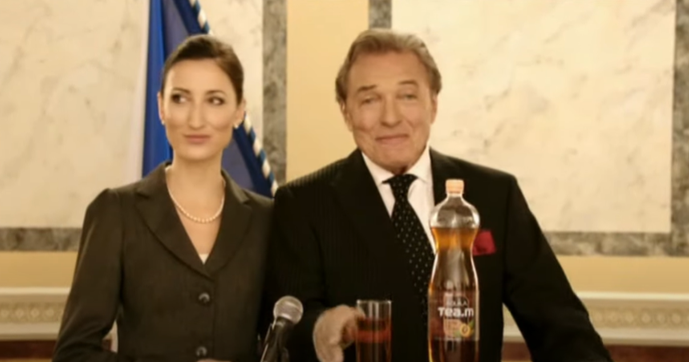
COMMERCIALS ARE A SECOND HOME TO CZECH CELEBRITIES. POPULAR ACTORS, RENOWNED ATHLETES AND EVEN KAREL GOTT HAVE EXPERIENCE WITH THEM
3. 5. 2023 | 19 min read We can hardly imagine today’s advertising without the involvement of public figures. The so called celebritisation has taken over the marketing world and many brands can’t do their campaigns without their ambassadors, influencers and mascots. The Czech Republic is no exception and the world of advertising is no attribute simply to the fact that it works. But it is interesting to note how many people have not resisted these temptations. I’m sure we could put together a long list of famous actors, singers, models, doctors and athletes. Some spots, of course, resonate more than others in the crowded media space, so it is not out of place to focus on those that can be described as memorable, given the popularity of the actors and the presentation itself. Even so, it seems that to list just ten of them is pitifully inadequate. How the nation got its dream president With the introduction of the direct election of the president, a virtually endless debate opened up in the Czech Republic on the topic of who citizens would imagine as the ideal inhabitant of Prague Castle. The names of popular personalities are more frequently mentioned than those of experienced politicians - Marek Eben, Jaromír Jágr or, at least until his death, Karel Gott, the father of Czech popular music. The company Karlovarské minerální vody (Karlovy Vary Mineral Waters) served people a taste of how the multiple winner of Zlatý slavík (Golden Nightingale) would have fared in the role of president back in 2011. The company joined forces with him in an advertising campaign promoting the new Aquila Team flavoured iced teas, which happen to be the new president's favourite drink. He even stands by their quality so much that he refuses to remove the bottle from the lectern where he is to deliver his speech to the nation. To the objection that the whole thing might be an advertisement, the Master replies, "Advertisement? I hope not." This is an allusion to the rather stubborn attitude with which Gott refused to participate in television commercials for many years. With a few specific exceptions, he only appeared in front of the cameras in this role after he turned 70. The company's costly investment (the fee is estimated to be in excess of CZK 10 million) reportedly paid off, and not long after the campaign was launched, Karlovarské minerální vody praised the improvement in sales. And what did the Master himself say? "I have tasted the tea and believe me, it is delicious cold. I also had the space to play a bit. You know, when I don't get any roles in films, I just have to take the ads." This is evidenced by the fact that he then appeared in several commercials before his death in 2019 - for example, in campaigns for ŠKODA AUTO or the Austrian rail carrier ÖBB.

A BASTION OF TRUST IN ADVERTISING: WHY DOES TELEVISION STILL WIN OVER MOST OTHER FORMATS?
24. 3. 2023 | 18 min read We live in world where we are constantly under attack by advertising from all directions. It is multiplicity that is the source of criticism from many pessimists who believe that marketing has got off the hook and appropriate to dismiss them entirely. The logical consequence of this is a loss of trust in various forms of marketing, mainly in online and social media marketing. By contrast, traditional media - and among them, primarily television - consistently enjoy a high level of user and consumer trust. Trust is still a highly sought-after commodity, but one that is paradoxically more scarce today than before. But television commercials, for example, continue to show us that if you want it, you can do it. SOCIAL MEDIA ARE NO MATCH FOR TRUST IN TRADITIONAL MEDIA Television emerges from opinion polls as one of the most trusted. Despite the ubiquitous realities of life in the digital age - or, conversely, it's just a symbol that the digital age has been overcome and we are slowly moving into a post-digital era that is far more critical than enthusiastic about cutting-edge technology. For example, a survey by analysts at mntn research offers concrete figures, revealing that TV and print advertising share first place in trust between adult respondents (nearly 50%). Pop-up ads, which are most commonly encountered on social media, came second in the ranking with just 19%.

SHOCK THERAPY ADVERTISING. WHEN DID IT WORK AND WHEN DID THE CREATIVES GO TOO FAR?
2. 3. 2023 | 14 min read Capturing the attention of the TV viewer is still one of the goals of marketers around the world. This field is becoming more and more complex as the market is filling up with all kinds of campaigns, so the consumer will appreciate those that are original, innovative and imaginative. But there is an old recipe that is still guaranteed to work - shock therapy. However, ad writers who manage to shock might still not pat themselves on the back after all. Marketing history is full of examples where not only did the desired effect not occur, but the response was strictly negative. Shock marketing is a category that, by its very nature, teeters on the edge. But we know of a number of campaigns that are universally considered good practice.

THE SUPER BOWL PHENOMENON AND HOW THE SPORTING EVENT OF THE YEAR ELEVATED TELEVISION ADVERTISING TO A PRESTIGIOUS DISCIPLINE
1. 2. 2023 | 19 min read In just a few day, nearly 100 million Americans will be in front of their TV screens. The Super Bowl finals are just around the corner. However, it’s not a purely sporting event, as it might seem. The eyes of marketing experts from all over the world will be on the State Farm Stadium in Glendale, Arizona, watching closely the commercials that are regularly broadcast during half-time. It’s practically the most expensive advertising slot ever, and it’s here that marketing trends are set for years to come. How is it possible that the Super Bowl is such a phenomenon? And how does it help form the current shape of what we consider to be truly quality television advertising? THE PURE ESSENCE OF AMERICA For Czechs, the whole concept of the Super Bowl may seem almost exotic, as we are not exactly used to such sporting events in this country. In a local context, the finals of the Czech First League, the top Czech competition, should function exactly like the Super Bowl. However, nothing like this is happening, we do not celebrate this event so massively. So how is the Super Bowl different? The answer may lie in the fact that the playoffs themselves are much less related to American football than it might seem to an outsider at first glance.

THE ECONOMIC CRISIS AS A MARKETING OPPORTUNITY? 2023 DOESN’T HAVE TO CRIPPLE COMPANIES, BRAND LOYALTY AND A TOUCH OF EMPATHY ARE THE KEYS TO SUCCESS
5. 1. 2023 | 12 min read Analysts around the world predict a challenging year for business. According to them, the past year was essentially a warm-up and the cost of living crisis will only become fully apparent in the coming months. This will undoubtedly be a challenge for marketers in all sectors, but there are also words of comfort and encouragement that we can add - while the world faced an unprecedented situation during the pandemic, the cost of living crisis is not something we have no historical experience of. There was a similar situation in 2008, and it provided a lot of lesson that we can apply now. Marketing and advertising experts even claim that the crisis is an opportunity to make an established brand even stronger. The key to this is strategies that do not abandon marketing in favor of a short-term performance boost.

BABY JESUS OR SANTA CLAUS? HOW CZECH CHRISTMAS ADS DIFFER FROM FOREIGN ADVERTISING
23. 12. 2022 | 7 min read Advent marks the beginning of a period when advertisers’ budgets are releasing larger sums of money into TV marketing. This is driven not only by the desire to thank their customers and wish them a prosperous new year, but also by the motivation to catch up with sales targets in the fourth quarter. According to statistics, investment in Christmas advertising rose by a billion in 2021 compared to the previous year. In recent years, many online retailers have joined traditional brand advertisers. TV advertising is valued by consumers as a great source of inspiration for Christmas shopping and also tops the charts in terms of relevance of recommendations and trust in the quality and value of products. In recent years, Christmas campaigns have also often been an unofficial competition to see who can film the spot that captures the audience’s heart, sticks best in their mind or (even) goes viral. TV ADVERTISING IS THE MOST CRUCIAL IN INFLUENCING CHRISTMAS SHOPPING BEHAVIOUR According to RTU, Christmas advertising has a big influence on what gifts people buy for their loved ones. According to research by Nielsen Admosphere, almost two-thirds of Czechs are influenced by Christmas advertising and the percentage of women is higher than men. Of course, with the popularity of social networks, customers are also inspired by other platforms, but they are only third on the scale. In the second place there’s the good old fashioned 'word of mouth', i.e. a recommendation from someone we know. But TV spots are still the best advisor when deciding on a gift for our loved ones. CZECH CHRISTMAS ADVERTISING HAS ITS SPECIFICS Most of the Czech commercials have one factor in common - fun. In the past, brands were often afraid to go down this route, but this tendency has been visibly modified in the Czech environment in recent years, and the domestic scene is gravitating towards funny ads. Czech creatives are not too keen on theatrical film environments and deeply moving advertising. Maybe it is due to a different culture or a limited budget, but as the creators of the 2006 spot for Vodafone with Petr Čtvrtníček proved, even with a small budget, Czechs can make funny and functional advertising that then goes viral on the Internet. NARRATIVE COMMERCIALS LIKE THE BRITISH ARE RARELY SEEN IN THE CZECH REPUBLIC Although Czech advertising (not only Christmas advertising) is to some extent influenced by foreign countries, it still keeps the Czech distinctive mentality at the forefront. Unlike the Czechs, British marketers try to create mostly touching and emotional content for Christmas. The preparation, execution and processing of advertising, which relies primarily on the story and the overall atmosphere, requires precise execution as well as a high budget. To make commercials such as those created by John Lewis, a legend of Christmas advertising, is a very high standard in terms of Czech budgets. Although it is not impossible, domestic filmmakers more often bet on easier (cheaper) forms of the concept.

TYPICALLY CZECH CHRISTMAS. IN THE CZECH REPUBLIC, HOLIDAY ADVERTISING IS HANDLED DIFFERENTLY, THE CREATORS ARE NOT AFRAID OF CONTROVERSIAL HUMOUR OR SERIOUS MESSAGES
8. 12. 2022 | 16 min read Czech Christmas ads are a category in themselves. It’s quite possible that abroad they would look in disbelief and awe at, for example, a Kofola pig, while for us the ad is the epitome of Christmas spirit. Of course, Czechs are no strangers to classically emotional and serious spots, and even excel at them. But the big domestic specificity is the fact that the most memorable advertising achievements are largely humorous pieces. Even so, they combine what we always look forward to at Christmas. The two categories then complement each other beautifully on the screen, creating a commercial mix that suggests that Christmas really is just around the corner! THE UNDYING LEGEND: KOFOLA - THE GOLDEN PIGGY Even Czechs have their own advertising that de facto heralds Christmas. Just as the UK has their John Lewis, we have our wild boar, but it lacks something to the golden one. The legendary Christmas advert doesn't seem to have aged at all since 2003, when it first appeared on TV screens. Unlike John Lewis, who year after year comes up with new original spots exquisitely rich in narrative, this domestic gem has made do with a few basic remasters and adaptations over nearly twenty years. The spot brilliantly combines honoring popular Christmas traditions with typical Czech situational humor. The main role here is played by the superstition of the golden pig that appears to those who fast on Christmas Eve. The popular catchphrase "No, I don't have to, I can see it already." is proof that this superstition can take on a whole new dimension when you go into the woods. This year, however, the re-launch of the ad will have a sad touch - on 1 November, its author Robert Peňažka died after a long illness. But for this achievement alone he will certainly never be forgotten, even though he himself admitted that no one expected the ad to become such a success. "With Kofola, the intention was not to create a legendary campaign at all, but to come up with a good Christmas campaign. That's the main ingredient. If you do it right, it will pay off and it has a chance to become a legend," he recalled in 2020. Well, in this case, he succeeded brilliantly.

CHALLENGE EVEN FOR THE BEST MARKETERS. WHY DOES A GOOD TV AD NEED TO GRAB THE VIEWER’S ATTENTION?
14. 11. 2022 | 19 min read Does it ever happen to you that while watching a commercial break on TV, an ad sticks in your mind so much that you have to think about it the next day? Or that you completely forget the “skip-ad” button when watching an ad before an online video? That is exactly the kind of situation where the real marketing experts rub their hands with satisfaction. They have just managed to grab your attention, which is an extremely difficult discipline that challenges even the most renowned brands. Is there any manual on how to tackle it with honour and create an ad that will become a viral hit?

THE MYTH OF “UNNECESSARY” MARKETING. WHY DOES IT PAY FOR COMPANIES TO INVEST IN PROMOTION IN TIMES OF ECONOMIC RECESSION?
27. 10. 2022 | 17 min read When the harsh reality of an economic recession hits companies, most of them tend to respond somewhat schematically according to the established rules of business logic. However, the more statistical data we have, the more clearly we see that these rules may not be as logical as they may appear at first sight. While in a worsening economic climate CEOs are cutting what they consider “unnecessary” costs - with advertising and marketing traditionally being the first to be cut - marketing experts advise exactly the opposite approach. Experts agree that you can advertise your services and products happily during a boom, but you absolutely must advertise during a recession. Why don’t companies realise this? INFLATION DOES NOT HAVE TO BURY MARKETING COMPLETELY We can draw useful data from an examination of the market response to the economic recession of the early 1980s. Just like today, it was triggered by the global energy crisis - at that time it was caused by the Iranian Revolution. As a result of that geopolitical upheaval, the price of oil began to soar. Later, this period became known in history as the ‘oil shocks’ that drove already high inflation in the Western world into double digits. Historians agree that this was the biggest economic crisis since the Second World War.

HOW TO DO ‘GREEN’ ADVERTISING? AUTHENTICITY AND A PROACTIVE APPROACH WIN WITH CONSUMERS, HYPOCRITES ARE PUNISHED
3. 10. 2022 | 19 min read We are living in a time of climate crisis and there is no point in turning a blind eye to it any longer. This is how one could sum up the efforts of many global companies that are giving more and more space to the environmental protection and sustainability in their advertising and marketing campaigns. It is clear that specific actions remain the responsibility of each of us, but these authorities can contribute to a complicated and heated public debate with their attitude and opinion. However, marketers should keep one thing in mind - the “preach water and drink wine”approach is becoming even more fatal in this peculiar discipline. Examples of good practice from abroad will give you a clue as to how to master this difficult task. ADVERTISING REVOLUTION IN the shades of GREEN At the turn of October and November last year, Glasgow, Scotland, hosted the 26th annual UN Climate Change Conference, known as COP26. It is traditionally considered one of the world's most important forums for discussion on climate, nature and landscape issues. To mark the occasion, the British media company Sky Media has decided to adjust its broadcasting schedule, including its commercial breaks. The reason was to sufficiently emphasise the course of the forum and the importance of the issues discussed for the TV audience. Viewers had the opportunity to watch the first ever ‘green’commercial break in British television history on Sky Media portfolio stations.

POPULAR HIT SONGS ARE A SAFE BET IN THE CZECH REPUBLIC. TEN EXAMPLES OF HOW FAMOUS TV COMMERCIALS HAVE WORKED WITH SONGS
22. 9. 2022 | 14 min read Even in the Czech Republic, we have no shortage of TV commercials that have given birth to new musical hits or helped revive forgotten ones. It may therefore seem like quite a superhuman task to choose just ten of them, but we tried anyway. In our selection, you will find ads that rely on the interconnectedness of the musical background with classic Czech humour, but also those that put pride and Czech national and cultural heritage at the forefront. In short, there is a lot to choose from. Please note, however, that many of these examples have the unfortunate trait that will inevitably get stuck in your head for a while. HERA - PEČENÍ JE RADOST, HERA JE PEČENÍ / BAKING IS A JOY, HERA IS BAKING (1998) Baking is a joy, Hera is baking! A slogan that has become so domesticated in the Czech Republic that no one will ever take it away from this baking product. The food company's advertising is largely traditional - it relies on classic scenes of family togetherness, where individual family members come together for the noble goal of creating a bakery masterpiece, which they then sit together over, full of joy. The visuals of the commercial look as if they have come straight out of Slováček's humorous novel Bylo nás pět (There Were Five of Us). This look is supported by both the vintage filter and the choice of the musical motif. Hera reached into the golden fund of Czech classical music and chose Humoreska by the internationally renowned composer Antonín Dvořák. All the compositions in the result form their own audiovisual symphony, during which you can't help feeling that you, too, could brush up on your baking skills and thus delight yourself and your loved ones.

WHEN MUSIC IS THE LAST STEP TO PERFECTION: THE WORLD’S TOP 10 ADS THAT BET ON THE POWER MUSIC
6. 9. 2022 | 12 min read Although it may seem at first glance that visual play the primary role in TV advertising, this is not so true. By the very nature of television as an audiovisual medium, it is obvious that the audio component has a firm and irreplaceable place in advertising. Music is one of the essential ingredients for success. This is something that many advertisements constantly convince us of, and which we are unable to put out of our minds for a long time afterwards. Sometimes commercials even even herald new music trends, sometimes they are the birth of global superstars. The following ten examples show the creative possibilities of working with music in advertising. All of them are united by the fact that they have an unquestionable place in the golden fund of television advertising. UNITED AIRLINES - RHAPSODY IN BLUE (1995; 2013) Opinions on air travel vary - some love planes, others have an unimaginable horror of them. But whichever one of these two groups you belong to, you can't deny this mode of transport a certain poetry and harmony that takes hold of you when you look out of the boarding window. Since the 1990s, United Airlines has been relying on this aspect of travel, urging its customers to „fly towards the friendly skies”. The campaign, which first drew attention to the fact that flying is actually a matter of customer comfort, has to some extent set the course for the airline industry. It's no wonder that United Airlines revived it a few years ago to the same success, banking mainly on the nostalgia of those who remember the original iteration. But time-tested things are not to be changed, which is why the original musical identity has been retained. Indeed, United Airlines is already so closely associated with American composer George Gershwin's symphony Rhapsody In Blue that it can hardly be claimed by anyone else - despite the fact that since the composer's death, the time limit for retaining the original copyright has passed. For it is hard to argue that the combination of Gershwin and planes criss-crossing the blue sky is not a visual symphony in itself.

BACK 2 SCHOOL! HOW DOES THE NEW SCHOOL YEAR START IN THE WORLD OF (NOT ONLY) TV ADVERTISING?
1. 8. 2022 | 16 min read The summer holidays have once again swung into their second half practically in the blink of an eye. With their inevitable end, it’s time to once again take charge of the responsibilities that many will find unavoidable in September. This is a reality for school children and students in particular, but for the younger ones it also affects their parents. All of this is a signal to advertising campaigners, for whom the Back 2 school season is one of the most exposed times of the year. Not participating is essentially a sin that shall be punished. Nor is participating poorly an entirely profitable strategy. What do the successful television commercials that have helped shape the phenomenon tell us about Back 2 school marketing?