
Most-read topics:
all GroupM VOD creativity efficiency aktv TV Nova TV Prima linear television attention AI QR
NEW FAMILY VIEWING DYNAMICS GIVE RISE TO A MODERN-DAY HEIRLOOM
29. 4. 2022 | 6 min read In a world rapidly filling with NFTs, crypto and metaverse musings, high-value possessions are not always tangible. Instead, digital attachments are just as sentimental as physical ones.

IN DEFENCE OF BRAND STORYTELLING
11. 4. 2022 | 5 min read Storytelling increasingly feels like a dirty word in marketing circles, connoting a flippant, regressive or trivial approach to the business of selling things. But marketers abandon it at their peril.

TV ADVERTISING IN THE DIGITAL AGE: STILL AN EFFECTIVE MEDIUM THAT IS OPEN TO NEW INFLUENCES
9. 4. 2022 | 11 min read In 1990s, TV advertising had to deal with the arrival of new video formats. It is no coincidence that new ads began to appear at the same time, building primarily on the growing popularity of digital technology. Unsurprisingly, they were dominated by the internet that was increasingly popular among users. Although the position of the internet was growing dynamically the impact of TV as a medium was not decreasing. Today, we are living in a streaming era which is again significantly changing the rules. However, it would be too simplified to say that linear TV and advertising have nothing to offer. First, it is not true. Second, TV has adjusted to the rapidly changing environment. So what is the position of classic TV advertising in the changing environment?

HOW TO GET LUCKY
5. 4. 2022 | 6 min read What bearing does luck have on advertising, asks Faris Yakob, who finds in a recent book - ‘Go Luck Yourself’ by Andy Nairn - a form of resilience that looks for what is possible with a rigorous examination of the situation.

BRING ON THE TECHNICOLOUR!
23. 3. 2022 | 6 min read There’s a scene in Kenneth Branagh’s Oscar-worthy Belfast where the film’s young hero Buddy is taken to the cinema to see the 1968 musical fantasy Chitty Chitty Bang Bang. Branagh’s movie is beautifully, brutally monochrome but the CCBB clip appears in its original glorious Technicolour, flooding the screen with warmth and transporting the Belfast audience - and the audience watching Belfast - to a happier, sunnier place.

THE CTV/OTT ADVERTISING INDUSTRY: WHAT LIES AHEAD IN 2022
15. 3. 2022 | 7 min read The explosive growth of Connected TV or CTV adspend is attracting new players and Unruly’s Lee Smith looks at how this will impact the issues of content, services and technology for the platform.

CTV ADVERTISERS ARE BETTING QR CODES AREN’T JUST A FAD
14. 3. 2022 | 5 min read Beyond the attention at the Super Bowl, TV marketers see QR codes as the golden ticket for measurement and conversions

CREATIVE ADVERTISING IS IN CRISIS
11. 3. 2022 | 9 min read The author of this article is Orlando Wood, Chief Innovation Officer at System1. The following text is a summary of his book Lemon, which has sparked a positive reaction and seems to have struck a chord with advertisers, agencies (planners and creatives), media owners and broadcasters. It seems to be the start of something new. There may even be a creative renaissance in the making.

HOW MARKETERS ARE LEVERAGING CREATIVE REFRESH FOR CTV SUCCESS
10. 3. 2022 | 5 min read Marketing teams are prioritizing the creative refresh as they work to drive video and CTV campaign performance.

IN ADVERTISING, THE PANDEMIC IS (MOSTLY) OVER
3. 3. 2022 | 5 min read After promoting masks and social distancing, advertising creative is officially moving on.

PRINCIPLES OF CREATIVE EFFECTIVENESS OR WHAT IS ‘GOOD CREATIVE’ ANYWAY?
2. 3. 2022 | 7 min read We have ways of testing creative, ways of measuring its effectiveness, but what do we actually know about how to make creative and effective advertising? asks Faris Yakob.

CMOS SHARE LESSONS ALL MARKETERS CAN TAKE FROM SUPER BOWL ADVERTISING
4. 2. 2022 | 5 min read The Super Bowl and its run-up represent the premier advertising event in our industry. According to Nielsen, 19 of the 20 all-time most-watched single network broadcast spots were an NFL Championship Game.

THE BIG BANG: CREATIVE AND MEDIA’S SURPRISING SECOND MARRIAGE
18. 1. 2022 | 10 min read Creative and media are finally getting back together. Just not in the way we imagined it would.

SORIN PATILINET AT COMMUNICATION SUMMIT 2021: UNRAVEL CUSTOMER EMOTIONS. IT’S THE PATH TO CREATIVE AND EFFECTIVE COMMUNICATION
26. 5. 2021 | 7 min read What are the lessons from the thousands of ads Sorin Patilinet has researched for brands like Whiskas, Orbit, Snickers and M&M'S? Take a look at the neuroscience findings that suggest what to look out for when creating ads and how to make them effective.

THE MOST EGG-CELLENT EASTER CAMPAIGNS
29. 3. 2021 | 5 min read It’s almost the hoppiest time of year (excuse the bad pun), and while we will be spending our long weekend enjoying lots of chocolate, Easter is also a significant retail event and an invaluable opportunity to give your marketing strategy an extra boost. This year, Australians are forecasted to spend $8.6 billion on holidays, chocolates, gifts and retail spending over the Easter period.

TV IS AT THE HEART OF CREATIVE EFFECTIVENESS
10. 3. 2021 | 2 min read In advertising, we have always known anecdotally that strong creativity leads to success, but there was little proof of the relationship until 2010, when the IPA, in association with Thinkbox, published 'The link between creativity & effectiveness' (updated in 2011).

EGTABITE 314: HOW GOLDBACH SWITZERLAND’S TV CAMPAIGN BOOSTED ONLINE BUTCHER SHOP LUMA
12. 10. 2020 This week’s meaty egtabite puts the spotlight on Goldbach Switzerland and the sales house’s effective TV campaign for the online butcher shop Luma Delikatessen. The creative campaign boosted brand awareness, provided an increase in both direct and search traffic and delivered a clear increase in turnover – with plenty of new buyers trying the online shop. Goldbach’s Brandformance attribution model At the beginning of April and mid-May, Luma launched their first-ever 20-second TV spot on the creation and mission of the specialised shop. The campaign period - in the midst of the COVID19 crisis - was marked by a general change in the use of media in the country, more particularly an increased use of online platforms, online stores, and streaming services.
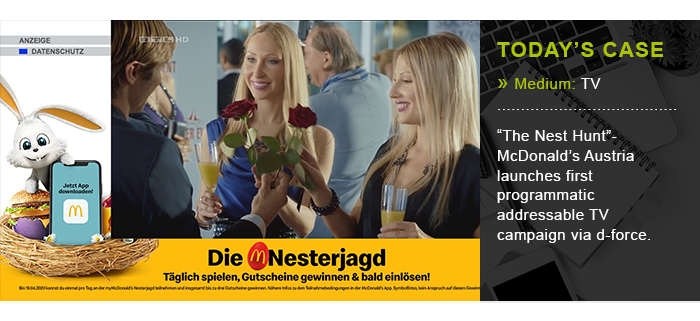
EGTABITE 299: “THE NEST HUNT”- MCDONALD’S AUSTRIA LAUNCHES FIRST PROGRAMMATIC ADDRESSABLE TV CAMPAIGN VIA D-FORCE IN AUSTRIA
24. 4. 2020 “The Nest Hunt”- McDonald’s Austria launches first programmatic addressable TV campaign via d-force in Austria