

What you will find in the article
- World Savings Day and Its Traditions
- A Look Back at the History of Savings Advertising
- Creative International and Czech Advertising Campaigns Full of Humour and Exaggeration
The history of World Savings Day, observed on 31 October, dates back to 1924, when the first International Savings Banks Congress was held in Milan, Italy. Representatives of savings banks and other financial institutions from 27 countries gathered to promote financial security and thrift. One of the main driving forces was the Italian professor Filippo Ravizza, who proclaimed World Savings Day at the close of the congress. The initiative was intended to restore public confidence in depositing money with financial institutions, which had been badly shaken by the First World War and subsequent inflation. The first major celebrations followed in 1925.
World Savings Day gradually took root, particularly in European countries with a strong savings-bank tradition. It was about more than simply encouraging financial responsibility. Savings banks held special events, handed out small gifts, worked with schools and sought to teach children how to manage money from an early age. In Vienna, for example, the celebrations became so popular that people would visit one savings bank after another, depositing small sums and collecting promotional gifts in return. In 1930s Czechoslovakia, a poster encouraging people to save through a credit union was produced to mark Savings Day.
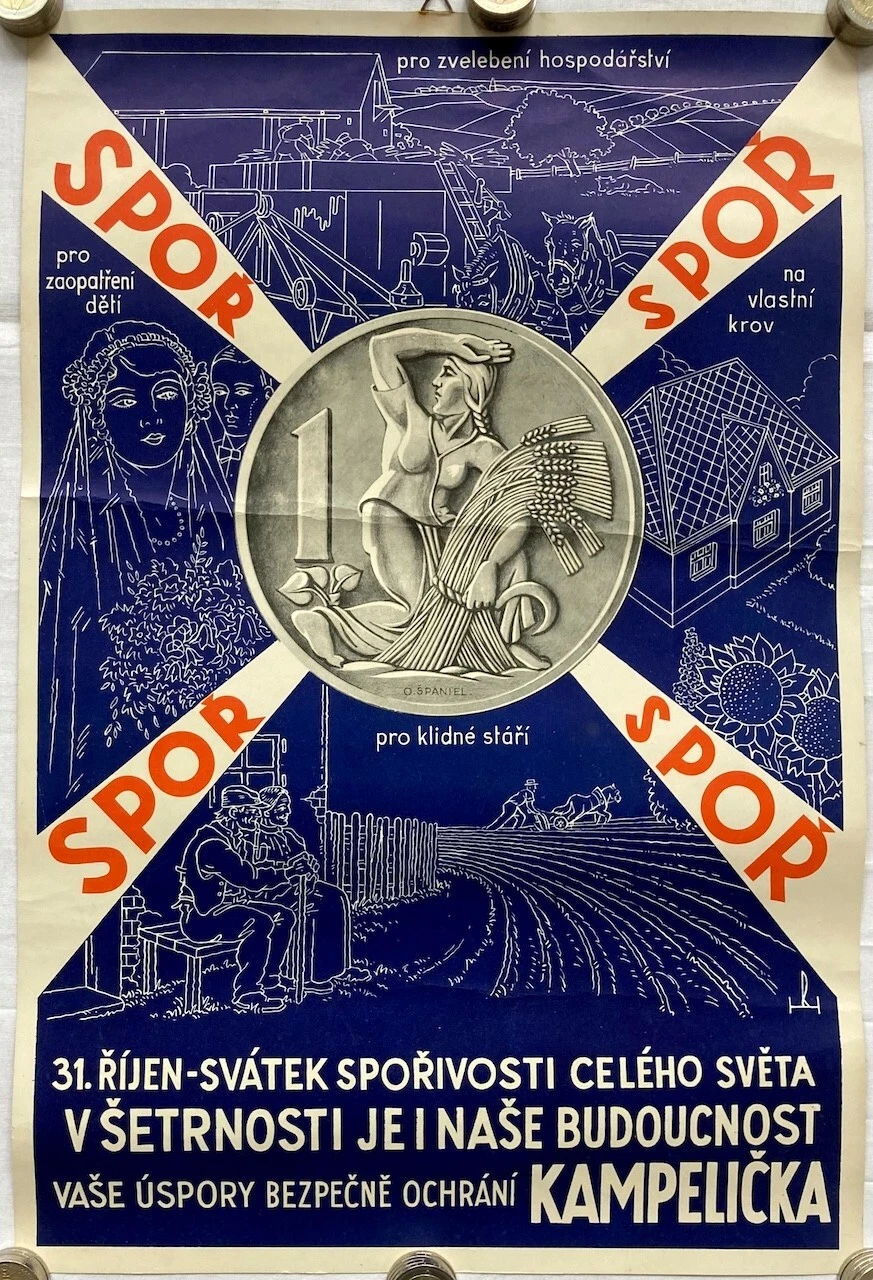
Saving even had its own anthem, written in 1928. The Savings Anthem originally had Italian lyrics, but gradually spread to other countries and languages. Czechoslovakia also took part in the international effort to promote it. Almost a century ago, then, financial institutions were already using tools that are familiar to us from modern marketing: music, memorable symbols and emotion.
The history of savings advertising
We may never know which television advert for savings products came first. Historic television archives are incomplete, and some of the earliest promotional films have been lost. One of the oldest surviving British television adverts for saving is “Premium Bonds: Xmas 1959”. In the one-minute film, Father Christmas presents British government-backed Premium Bonds as the perfect Christmas gift. Rather than promising high interest rates, the advert plays on the thrill of a possible win. At the time, each £1 bond provided entry into a monthly prize draw with a top prize of £1,000. The advert feels nostalgic today, but its underlying approach is surprisingly modern: selling a financial product through emotion and storytelling.
Video: Premium Bonds: Xmas (1959)
Banks and government bodies soon realised that celebrities could help promote saving. In the United States, Hollywood stars, television actors and cartoon characters helped popularise US savings bonds. Among those who lent their names to the cause were Lucille Ball, Desi Arnaz and John Wayne. In 1961, a promotional film even featured the popular cartoon characters Rocky and Bullwinkle, encouraging children to start with savings stamps and move on to bonds later in life.
Video: Uncle Sam Speaks – Video Clips Promoting Bonds Compilation
Australia, meanwhile, saw a television advert for a children's savings account featuring Skippy, the popular television kangaroo, in the 1960s. Commercial Banking Company tempted young savers with a furry Skippy money box, complete with a joey. The animated advert also used the familiar theme tune from the television series of the same name. Partnerships between brands and film or television characters are clearly nothing new.
The promotion of saving has a long history in the Czech lands, too. The first savings bank was established there as early as 1825, with the aim of helping people on low and middle incomes become more financially independent. Over time, however, competition grew, as did the need to convince people that their money belonged in a savings bank rather than hidden under the mattress. One of the earliest documented examples of savings-bank advertising in what is now the Czech Republic is a leaflet issued by the municipal savings bank in Přerov in 1885, highlighting the benefits of depositing money.
At the time, advertising was primarily educational. It explained why people should save, how interest worked and how regular deposits could support them in old age. By the 20th century, savings banks were using posters, punchy slogans and mascots. Advertising was also put to political use. In socialist Czechoslovakia, slogans included “Prosperity through work, contentment through savings” and “Your savings benefit your country, your family and yourself”. Alongside personal financial security, saving was presented as a way of serving society and the state.
Today's savings advertising is radically different from its predecessors. Whereas banks once focused mainly on responsibility, security and the future, modern campaigns are happy to embrace irony, absurdity and even outright mockery of banking stereotypes. Sometimes they barely mention the interest rate at all, preferring instead to tell a story designed to make viewers laugh or catch them by surprise. As the following examples show, there is virtually no limit to the imagination involved. Some of these campaigns have not only entertained millions of viewers but also won prestigious advertising awards or attracted considerable media attention.
International examples of television advertising for savings
Australian ING has also embraced originality. What could make a better impression on a first date than an expensive car or a luxury dinner? Regular saving, perhaps… In August 2026, the bank launched its “Saving Is In” television campaign, in which a man boasts on a first date that he has already reached his monthly savings target. When he then asks for a discount, his frugality inspires an unexpectedly enthusiastic reaction. Both his date and the waiter immediately propose to him. The advert uses exaggeration to turn everyday saving into an attractive personality trait. The campaign was created by Ogilvy Australia.
This was no random idea. According to an ING survey, 46% of single Australians surveyed said they were attracted to people who save regularly. A further 41% regarded the ability to stick to a budget as an attractive quality. ING therefore built its advert around the notion that financial responsibility is the new romantic trump card.
Video: ING Australia – Saving Is In
British building society Nationwide, meanwhile, chose to promote saving through a character who embodies everything wrong with traditional banking. In the February 2024 advert “In Your Best Interest”, actor Dominic West, known for The Wire and The Crown, plays the arrogant boss of a fictional bank called A.N.Y Bank. He looks bored during a video conference, ignores reports of unhappy customers and prefers to concern himself with shareholders' interests. His eager assistant, played by comedian Sunil Patel, tries in vain to explain why the bank should offer customers a better service. The advert promotes SavingsWatch, which alerts Nationwide customers to new savings accounts and more competitive interest rates.
Video: Nationwide – In Your Best Interest (2024)
The humour rests on a simple contrast: while the fictional bank is concerned chiefly with its own interests, Nationwide wants to be seen as an institution that puts customers first. The campaign also proved controversial. An earlier advert in the series, about bank branch closures, was even banned by the UK's Advertising Standards Authority. Nationwide demonstrated that banking advertising can be not only funny but deliberately provocative.
Slovakia's Všeobecná úverová banka also came up with an unusual idea: rather than warning against unhealthy financial habits, it presented saving as an addiction that nobody would want to kick. The “Savings Therapy” campaign, devised by TRIAD Advertising, featured actress Petra Polnišová in a humorous group-therapy setting. The adverts promoted the idea that regularly putting money aside could be addictive in the best possible sense. Karel Janák directed the television element of the campaign. But the television advert was only the beginning. The agency also developed a special browser extension which displayed a “Save Instead” alternative alongside the “Add to basket” button on Slovak online shops. The campaign received exceptional recognition: at the Effie Awards Europe 2020, it won the top prize, the Grand Effie. According to the agency's figures, new savings deposits during the campaign totalled €79 million, comfortably exceeding the original target of €54 million.
Video: VÚB Savings Therapy – Case Study
British bank Santander took a different approach in 2019, enlisting the popular presenting duo Ant and Dec, namely Anthony McPartlin and Declan Donnelly. In the advert, they introduce their own bank, Antandec, which bears a suspicious resemblance to Santander. Viewers learn that television presenting was merely a temporary stop on the pair's journey towards their real dream: starting a bank. Their supposed innovations are utterly absurd. Although the advert primarily promoted mortgages and related services, its popularity demonstrated the power of humour in financial advertising. According to YouGov, awareness of Santander's advertising rose from 11% to 32% during the campaign. Not all responses were positive, however, and some measures of brand perception fell temporarily. Even so, the advert achieved something remarkably difficult in banking: it got people talking about the campaign outside the ad breaks.
Video: Santander – Bank of Antandec (2019)
In 2025, the UK workplace pension scheme Nest joined forces with the renowned animation studio Aardman, the creators of Wallace and Gromit and Shaun the Sheep. The result was a pair of 30-second animated adverts that turned everyday workplace situations into humorous tales from the world of birds. The stories were narrated by British comedian Bill Bailey. Creative agency Atomic London also worked on the campaign.
Video: Nest Pensions – Meetings & Menus
The adverts are built around a simple idea: while people get on with their jobs and everyday lives, their retirement savings grow steadily in the background. Instead of numbers, charts and financial jargon, the campaign uses playful characters, humour and easily remembered metaphors.
In 2025, the Irish government chose an unusual animated advert starring an ice cream to introduce its new automatic-enrolment retirement savings scheme, My Future Fund. Over the course of the 30-second film, a wafer cone is assembled before the viewer's eyes, with scoops of ice cream added one by one. Each scoop represents a contribution from either the employee or the employer, while the cherry on top symbolises the state's contribution. The advert neatly illustrates how people can build up retirement savings with support from two other contributors. Irish agency Creed developed the creative concept in collaboration with Second Home Animation Studios. Directed by Chris Randall, the advert was made using stop-motion animation, a technique involving photographing physical objects frame by frame. Its creators also used 3D printing and a specially formulated material resembling ice cream that would not melt during filming.
Video: My Future Fund – Continue Protecting Your Future
We conclude our selection of international savings adverts with a campaign from Greek digital bank Snappi. This year, it unveiled an unconventional campaign starring pockets brought to life. Six distinctive puppet characters represent different attitudes towards money and sing a humorous song about everyday financial worries. The campaign was created by The Newtons Laboratory, produced by Filmiki Productions and directed by Violeta Tseli.
Video: Το λέει η τσέπη σου | Snappi
The advert stood out above all for its unusual visual style and its combination of humour, music and handmade puppets. Some viewers even assumed the characters had been created using artificial intelligence, prompting the makers to release a behind-the-scenes video showing how they were actually made. The campaign turned an otherwise routine message about banking benefits into an original, memorable spectacle.
Czech television adverts about saving
Czech banks are no strangers to experimentation in television advertising either, showing that even the seemingly serious world of finance can offer plenty of entertainment. Over the years, viewers have taken to a host of advertising characters, unforgettable catchphrases and well-known personalities who have become the faces of banking brands. Although savings accounts and other financial products are relatively challenging subjects for advertisers, Czech creatives have repeatedly shown that promoting them need not be dull. Here are a few Czech campaigns that have stood out for their fresh ideas, humour or striking creative execution.
In 2023, Air Bank retired its famous two bankers advertising concept after 12 years. The pair had represented the contrast between traditional and modern banking. Rather than relying on the two characters' playful rivalry, the new “Even That Can Happen” campaign explored absurd chains of events. In the Exotic Holiday advert, which promoted a savings account, the story takes viewers to a deserted island, where the protagonist encounters a previously undiscovered species of creature. Another advertising adventure leads customers to a hotel built out of a giant pumpkin. Air Bank was playing with the so-called butterfly effect: a small change at the outset can have major, unexpected consequences. Actor Tomáš Měcháček remained in the adverts, but instead of sparring directly with a rival banker, he now commented on the new stories.
Video: Air Bank – Exotic Holiday (2023)
Fio banka has featured Štěpán Kozub and Petra Nesvačilová in its television advertising for several years. At the turn of 2024 and 2025, their advertising adventures moved from the world of travelling fairgrounds to a rural farm. The new “For All Life's Earthly Pleasures” concept casts the actors as Přéma and Boženka, who find themselves in all manner of bizarre situations on their farm. One advert has the telling title “Money Doesn't Belong Under Your Pillow – Invest It Instead”. Although it promotes investing rather than a conventional savings account, it fits neatly into the broader theme of managing savings wisely. The advert was created by Jinej Gang, directed by Daniel Růžička, with visual effects by UPP.
Video: Fio banka – Money Doesn't Belong Under Your Pillow (2025)
Partners Banka took a completely different route. When it launched on the Czech market in 2024, it enlisted singer-songwriter Pokáč, who composed an original song for the bank. Individual verses formed the basis of four television adverts. Rather than offering detailed explanations of banking products, the campaign relied on a catchy tune, gentle humour and a clear introduction to the new bank. The song's chorus also became a jingle used in the bank's advertising over the longer term. The campaign was devised by Moebius, with Pokáč himself as its main star.
The song paid off from a marketing perspective, too. According to testing carried out by Behavio, the finished advert elicited a positive response from 62% of respondents, while 54% correctly recalled that it was advertising a bank. The campaign also won the Souboj spotů advertising competition organised by the trade weekly Marketing & Media.
Video: Partners Banka – Pokáč (2024)
Raiffeisenbank, for its part, launched a campaign in January 2019 for its eKonto XL account, using a visual style reminiscent of a detective investigation. Through the lens of an imaginary hidden camera, viewers watched bankers suspiciously putting an offer in a branch window, or a customer leaving the bank with a mysterious expression. The entire advert was assembled from a series of photographs, giving it an unusual rhythm and atmosphere. The creative concept was developed by Made by Vaculik in collaboration with photographer Marek Musil. The bank went on to develop the detective theme in further campaigns throughout 2019. At a time when banking adverts often focused on straightforward lists of benefits, Raiffeisenbank went its own way, seeking to build suspense and curiosity. Viewers were left feeling they were watching the unravelling of a great financial mystery rather than an ordinary product offer.
Video: Raiffeisenbank – Detective-Style Savings Account Advert (2019)
Savings change, but a good story endures
Savings advertising has come a long way. A century ago, its main aim was to teach people financial responsibility; today, it shows them that managing money wisely can also be fun, appealing or even adventurous. Financial institutions no longer base their messaging solely on interest rates. They also try to give customers a sense of security, freedom or confidence in their decisions – or simply capture their attention with a good story.
World Savings Day, then, is more than a reminder that we should put some money aside. It is also a chance to reflect on how our attitudes towards finance have changed, along with the way banks communicate with us. And if an advert for a savings account can make us laugh, surprise us or give us something to think about today, perhaps it has achieved something the creators of 19th-century savings-bank posters could only have dreamed of.